

50/30/20 Budget Explained With Real Examples
The 50/30/20 Budget is popular for a simple reason. It gives a clear way to divide monthly income without building a complicated sheet on day one. Many people want a money management system that feels easy to start, easy to repeat, and flexible enough for real life costs. This budgeting percentage rule can do that, as long as you understand what the buckets mean and how to adjust them when rent, debt, or family expenses push the numbers around.
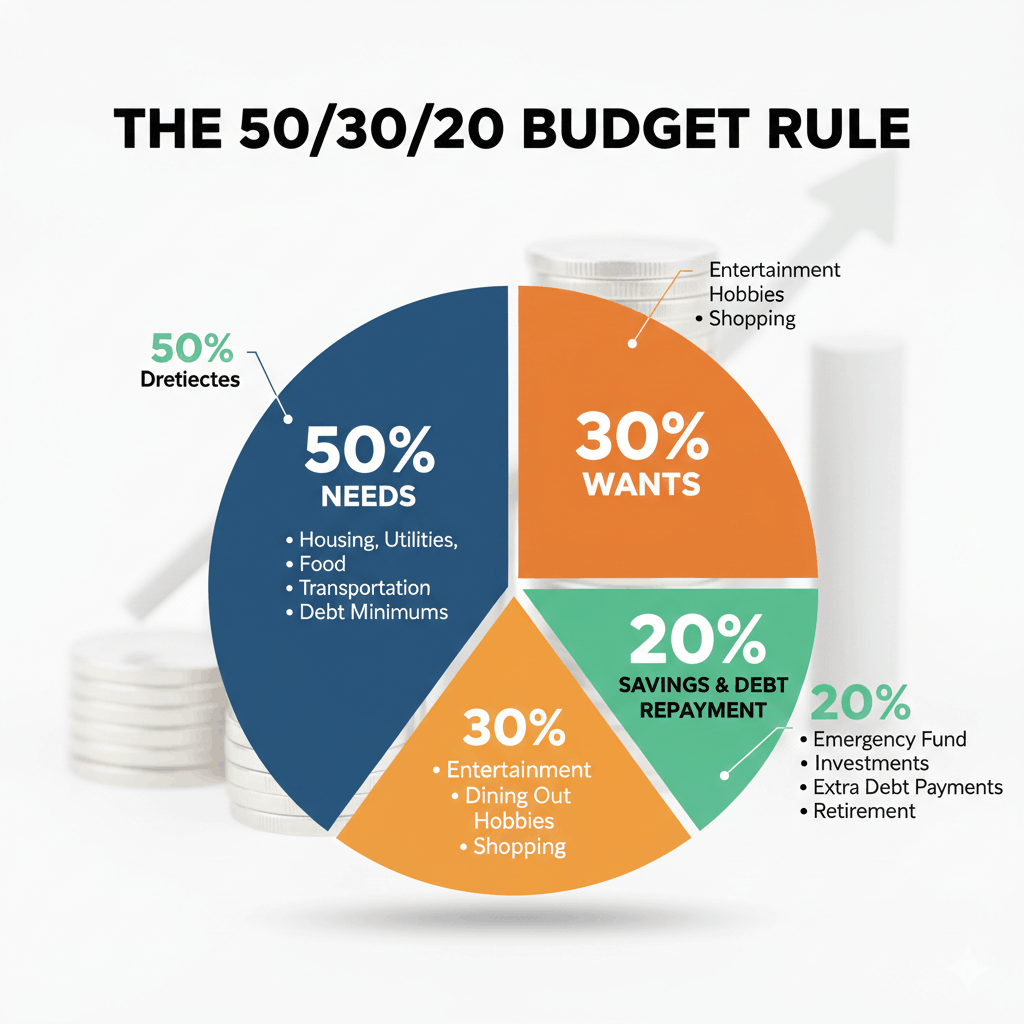
This guide explains the 50/30/20 budget rule in plain language, then walks through real examples with different incomes. You will learn how to divide income 50 30 20, how to classify needs wants savings budget categories, how to set a discretionary spending limit that feels realistic, and how to use expense tracking budget habits so the plan keeps working month after month. You will leave with a monthly budget breakdown you can apply right away, plus practical ways to handle emergency fund savings, debt repayment budgeting, and long term savings plan goals.
Intent
People searching 50/30/20 Budget and related terms usually want two outcomes.
First, they want the 50/30/20 rule explained with clear categories and simple math.
Second, they want a realistic budgeting plan that fits their life. Many readers try a budgeting formula once, then quit when one bucket runs over. Real examples and adjustment rules turn the budgeting framework into a balanced budget strategy that can hold up across normal monthly surprises.
Quick stats snapshot to frame why this method matters
Households in many places are under pressure from higher living costs and expensive borrowing. Official U.S. data reported a personal saving rate near 4 percent in September 2025, which shows how hard “saving 20 percent income” can feel for a lot of people. Credit card interest rates have hovered around the low 20 percent range in late 2025, which makes debt repayment budgeting more urgent for anyone carrying a balance. In a 2025 workplace financial wellness report, about two thirds of workers reported living paycheck to paycheck, a reminder that budgeting for beginners needs flexibility and clear priorities.
You do not need to memorize these numbers. The point is simple. Many households have little margin. A budgeting framework that keeps spending organized can create that margin over time.
What the 50/30/20 Budget rule means
The 50/30/20 budget rule is an income allocation rule. It splits take-home income into three buckets.
50 percent goes to needs.
30 percent goes to wants.
20 percent goes to savings and goals.
This is a budgeting percentage rule, not a strict law. The buckets give structure. Your real life numbers decide how close you can stay to the split.
The 50 30 20 budgeting method works best when you treat it like a budgeting framework that guides decisions, not a rigid set of limits that triggers guilt when life changes.
50/30/20 rule explained with one clear idea
The rule creates three guardrails.
The needs bucket keeps must-pay bills covered.
The wants bucket sets a discretionary spending limit so lifestyle spending stays controlled.
The 20 percent bucket protects your future. It covers emergency fund savings, long term savings plan goals, and debt repayment budgeting that goes beyond minimum payments.
A lot of stress comes from mixing these buckets. When wants quietly eat into needs money, bills feel tight. When needs swallow everything, savings disappears. The rule helps you see the tradeoffs.
How to divide income 50 30 20 in two minutes
Start with take-home income. Take-home means money that lands in your account after taxes and payroll deductions. If you receive irregular pay, start with a conservative monthly average.
Then calculate your targets.
Target for needs = take-home income × 0.50
Target for wants = take-home income × 0.30
Target for savings and goals = take-home income × 0.20
If your monthly income is 3,000, the targets look like this:
Needs target: 1,500
Wants target: 900
Savings and goals target: 600
That is the budgeting formula. The next step is the part that makes it useful: deciding what goes where.
Needs wants savings budget categories that make sense
A needs wants savings budget falls apart when “needs” becomes a label for everything. The easiest way to classify spending is to ask one question.
If you stop paying this, do you lose housing, basic utilities, basic transport to work, or minimum debt obligations?
If yes, it fits the needs bucket.
If no, it fits wants or savings.
Needs bucket: what belongs in the 50 percent
Needs are the costs that keep life stable and keep you earning income.
Common needs include:
- Rent or mortgage
- Basic utilities
- Basic groceries for home meals
- Transport costs tied to work and family obligations
- Minimum payments on loans and credit cards
- Insurance premiums
- Basic phone and internet needed for work or school
The word “basic” matters. A premium upgrade can move into wants.
Wants bucket: what belongs in the 30 percent
Wants are optional lifestyle choices. Wants can improve quality of life. Wants can exist in a healthy budget. The wants bucket is where most overspending happens, so clear categories help.
Common wants include:
- Eating out, takeout, coffee runs
- Streaming subscriptions and entertainment
- Upgrades on phone plans, gadgets, clothing, and personal care
- Hobbies and sports memberships
- Vacations and weekend trips
- Gifts that go beyond what your plan can support
Wants are not “bad.” Wants just need a boundary. That boundary is your discretionary spending limit.
Savings and goals bucket: what belongs in the 20 percent
The 20 percent bucket is where the budget rule for saving money lives. This bucket protects future stability. It often includes a mix of savings and debt.
Common items in the 20 percent bucket:
- Emergency fund savings
- Extra payments for debt repayment budgeting
- Retirement contributions and investing
- Sinking funds for irregular big costs
- A long term savings plan for major goals like education or a home down payment
Saving 20 percent income is the default target. Many people start lower. That is fine. The goal is consistent progress.
Gray area spending that confuses most people
Some costs sit between needs and wants. Put them in the bucket that matches your real choice.
Car payment: a modest car that gets you to work can be a need. A higher payment for a luxury upgrade fits wants.
Groceries: basic groceries fit needs. Premium snacks and “just for fun” extras can be treated as wants if the food category keeps running high.
Phone plan: a basic plan fits needs. An upgrade for extra perks fits wants.
Child expenses: basics fit needs. Optional extras fit wants.
When two people share a household budget planning system, agree on gray areas together. This avoids arguments later.
Monthly budget breakdown you can copy
You can apply the 50/30/20 Budget with a simple monthly budget breakdown. You do not need a complicated tool to start.
Step one: write your take-home income.
Step two: write your three bucket targets.
Step three: list the major items under each bucket.
Step four: compare your real spending to the targets and adjust.
If you want a cleaner system, use a spreadsheet. If you prefer paper, use a printed page. The 50/30/20 budgeting method works with either approach.
Real example 1: budgeting for beginners on a tight income
Take-home income: 1,800 per month
50 percent needs target: 900
30 percent wants target: 540
20 percent savings target: 360
Now look at reality.
Rent: 750
Utilities: 120
Groceries: 220
Transport: 140
Minimum debt payments: 120
Needs total already hits 1,350. That is 75 percent of income.
This is where people think the rule “fails.” The rule is still useful. It shows the problem clearly. Needs are taking more than half, so the wants bucket must shrink and the 20 percent bucket may start small.
A realistic budgeting plan might look like this:
Needs: 1,350
Wants discretionary spending limit: 300
Savings and goals: 150
This is still an income allocation rule. The split changed to match life. The goal becomes financial stability planning. The plan focuses on three moves.
First move: protect bills and minimum payments.
Second move: start emergency fund savings, even if it is small.
Third move: work on reducing the needs load over time, often through housing choices, transport costs, or debt payoff progress.
In this example, emergency fund savings might start at 50 per month. Debt repayment budgeting might get the remaining 100 as extra payments to reduce interest costs.
The win is consistency. Once debt drops or income rises, you can grow the 20 percent bucket.
Real example 2: a balanced budget strategy when the rule fits well
Take-home income: 3,500 per month
Needs target: 1,750
Wants target: 1,050
Savings and goals target: 700
Now build the monthly budget breakdown.
Needs:
Rent: 1,150
Utilities: 200
Groceries: 400
Transport: 250
Insurance: 150
Minimum debt payments: 200
Needs total: 2,350
Needs are above the 1,750 target. This situation is common in higher rent areas. The adjustment can happen in two places.
Option A: treat this month as a transition month and reduce wants to keep saving progress.
Option B: work on lowering needs across time, then return closer to 50 percent.
A realistic budgeting plan for this month:
Needs: 2,350
Wants discretionary spending limit: 450
Savings and goals: 700
This keeps the 20 percent bucket intact. That matters for financial stability planning.
Now allocate the 20 percent bucket:
Emergency fund savings: 300
Debt repayment budgeting (extra): 200
Long term savings plan: 200
This is a strong money management system. It supports present life, future stability, and debt reduction. It is not “perfect 50/30/20,” yet it respects the purpose of the budgeting framework.
Real example 3: using the 20 percent bucket for a long term savings plan
Take-home income: 6,000 per month
Needs target: 3,000
Wants target: 1,800
Savings and goals target: 1,200
Assume needs come in at 2,700 due to manageable housing and low fixed costs.
That leaves room to choose a balanced budget strategy:
Needs: 2,700
Wants discretionary spending limit: 1,800
Savings and goals: 1,500
This goes beyond “saving 20 percent income.” That extra margin can accelerate financial stability planning.
A strong 20 percent bucket plan here could look like this:
Emergency fund savings: 500
Debt repayment budgeting (extra): 400
Long term savings plan: 600
People with more margin often want a simple budgeting method that prevents lifestyle creep. The 50/30/20 Budget helps keep that boundary in place by giving wants a clear ceiling.
Real example 4: household budget planning with shared goals
Take-home household income: 4,800 per month
Needs target: 2,400
Wants target: 1,440
Savings and goals target: 960
Household budgeting works better when personal spending is agreed in advance. Many conflicts come from unclear wants spending.
A practical structure:
Needs:
Housing and utilities: 2,050
Groceries: 550
Transport: 350
Insurance and minimum debt payments: 450
Needs total: 3,400
Needs are high. So the plan shifts.
Wants discretionary spending limit: 550
Savings and goals: 850
Now split wants fairly:
Adult A personal spending: 200
Adult B personal spending: 200
Family fun and dining: 150
Then set the 20 percent bucket priorities:
Emergency fund savings: 300
Debt repayment budgeting (extra): 350
Long term savings plan: 200
This is a money management system that reduces conflict. It gives each person room for personal choices inside a boundary.
Where debt repayment budgeting fits inside the 50/30/20 Budget
Debt is usually handled in two layers.
Minimum payments belong in the needs bucket. They are must-pay commitments.
Extra payments belong in the 20 percent bucket. That is where debt repayment budgeting accelerates.
If debt is heavy, the fastest way to improve financial stability planning is often to lower the wants bucket for a period of time. That creates extra money for debt payoff without risking missed payments.
A simple approach:
Step one: cover minimum payments inside needs.
Step two: put a consistent extra payment inside the 20 percent bucket.
Step three: track progress monthly. When one debt is cleared, redirect that payment into the next goal.
Emergency fund savings inside the 20 percent bucket
Emergency fund savings protects the budget from sudden costs. Without a buffer, one surprise can push spending onto credit and undo months of progress.
A common starter goal is a small cash cushion that covers a few weeks of costs. Many people aim for a larger fund later. The exact target depends on job stability, family size, health needs, and income volatility.
If saving 20 percent income feels out of reach, start with a smaller percent that you can maintain, then increase as the needs load drops. The rule still helps, since it keeps savings on the page every month.
Cash flow management: the hidden reason budgets feel tight
Cash flow management is about timing. Two people can earn the same amount and have the same spending totals, yet one person struggles with mid-month shortfalls.
The fix is simple: match bill timing to pay timing.
If pay hits weekly, divide needs costs into weekly targets. If pay hits twice monthly, assign half of major bills to each paycheck. If bills hit early and pay hits later, keep a buffer in the account so the first half of the month stays stable.
This is part of a balanced budget strategy. It keeps the plan usable across the full month, not just on paper.
Expense tracking budget habits that keep the rule working
The 50/30/20 Budget is easy to set up. Sticking to it is an expense tracking budget problem, not a math problem.
You need a simple routine. Not a daily obsession. A short check once a week is enough for most people.
A weekly check-in can include three steps.
Step one: total spending so far in needs and wants.
Step two: compare to the month targets.
Step three: adjust your discretionary spending limit for the next week if the wants bucket is running hot.
Expense tracking budget habits turn the budgeting framework into a real money management system. Without tracking, the numbers drift.
Smart money habits that support financial discipline
Financial discipline is easier when the environment supports it. You do not need extreme restriction. You need repeatable habits.
A few smart money habits that support the 50 30 20 budgeting method:
Keep wants spending in one or two categories you can see easily, like dining and entertainment. Too many categories can hide leaks.
Create a pause rule for bigger wants purchases. A short delay often lowers impulse buys.
Make saving automatic when possible. Emergency fund savings works best when it happens early, not at the end of the month.
Reduce small recurring charges. Subscriptions often inflate wants without feeling like “spending.”
These habits reduce the mental load. They strengthen financial discipline across time.
Budget rule for saving money when needs are higher than 50 percent
Many readers live in cities where housing alone can take half of income. In that case, the 50/30/20 budget rule becomes a direction, not a strict outcome.
Use the rule as a lens.
If needs are 60 to 75 percent, it signals that wants must be smaller and savings may start modest.
Then use the 20 percent bucket idea as a goal to grow toward. Each time you lower a fixed cost or pay off a debt, you free up space. That space can move to savings and goals.
This is financial stability planning in action. Small changes compound.
How to set a discretionary spending limit that feels realistic
A discretionary spending limit should feel slightly tight, not impossible.
If you set wants too low, the budget breaks and tracking stops.
If you set wants too high, goals get pushed out forever.
One practical way to set the wants limit is to look at last month’s wants total, then reduce it by a small amount. Keep the cut small enough that you can repeat it. Repeat matters more than a dramatic cut that lasts five days.
Common mistakes people make with the 50/30/20 Budget
Using gross pay instead of take-home pay
The budgeting formula is meant for take-home pay. Using gross pay inflates the buckets and creates frustration mid-month.
Treating wants as needs
This is the most common reason the needs bucket grows beyond 50 percent. Small upgrades add up.
Ignoring irregular big costs
If you do not plan for annual fees, car repairs, medical costs, school items, and gifts, the wants bucket gets blamed for problems it did not cause. Put a monthly amount inside savings or needs to cover these costs.
Skipping tracking
The rule works when spending is visible. Without expense tracking budget habits, the categories drift and goals get delayed.
Adjusting the 50/30/20 budgeting framework without losing its purpose
The purpose is balance.
Your bills stay paid.
Your lifestyle spending stays controlled.
Your future gets funded.
If you adjust the percentages, keep that purpose intact.
If needs rise, shrink wants first.
If debt is expensive, grow the 20 percent bucket by lowering wants.
If income is irregular, use a conservative monthly baseline and treat extra pay as goal money.
This keeps the income allocation rule working in any season of life.
A simple monthly reset plan
At the start of each month:
Write take-home income.
Calculate your 50/30/20 targets.
Write a monthly budget breakdown in three short lists: needs, wants, savings.
Pick one goal for the 20 percent bucket: emergency fund savings, debt repayment budgeting, or a long term savings plan milestone.
Schedule one weekly check-in to keep spending visible.
That is enough to keep the money management system running.
Final thoughts
The 50/30/20 Budget is a simple budgeting method that helps people make better choices with less stress. It works best as a budgeting framework that you can adjust to match real life. Use it to set clear boundaries for needs, set a discretionary spending limit for wants, and protect savings goals inside the 20 percent bucket. Over time, expense tracking budget habits and consistent weekly check-ins create a balanced budget strategy that supports financial discipline and long term savings plan progress.


