
Debt Snowball vs Debt Avalanche: Pick the Right One for You
Debt payoff feels simple on paper: pay what you owe, keep going until the balances hit zero. Real life is messier. Interest keeps adding pressure, budgets stretch, and motivation fades at the exact moment you need it most.
That is why the debt snowball vs debt avalanche conversation matters. These are two popular debt payoff strategies that give you a clear debt payoff order strategy. Both can work. Both can fail. The difference is not only math. It is also momentum, habit, and the kind of feedback your brain needs to stay steady for months.
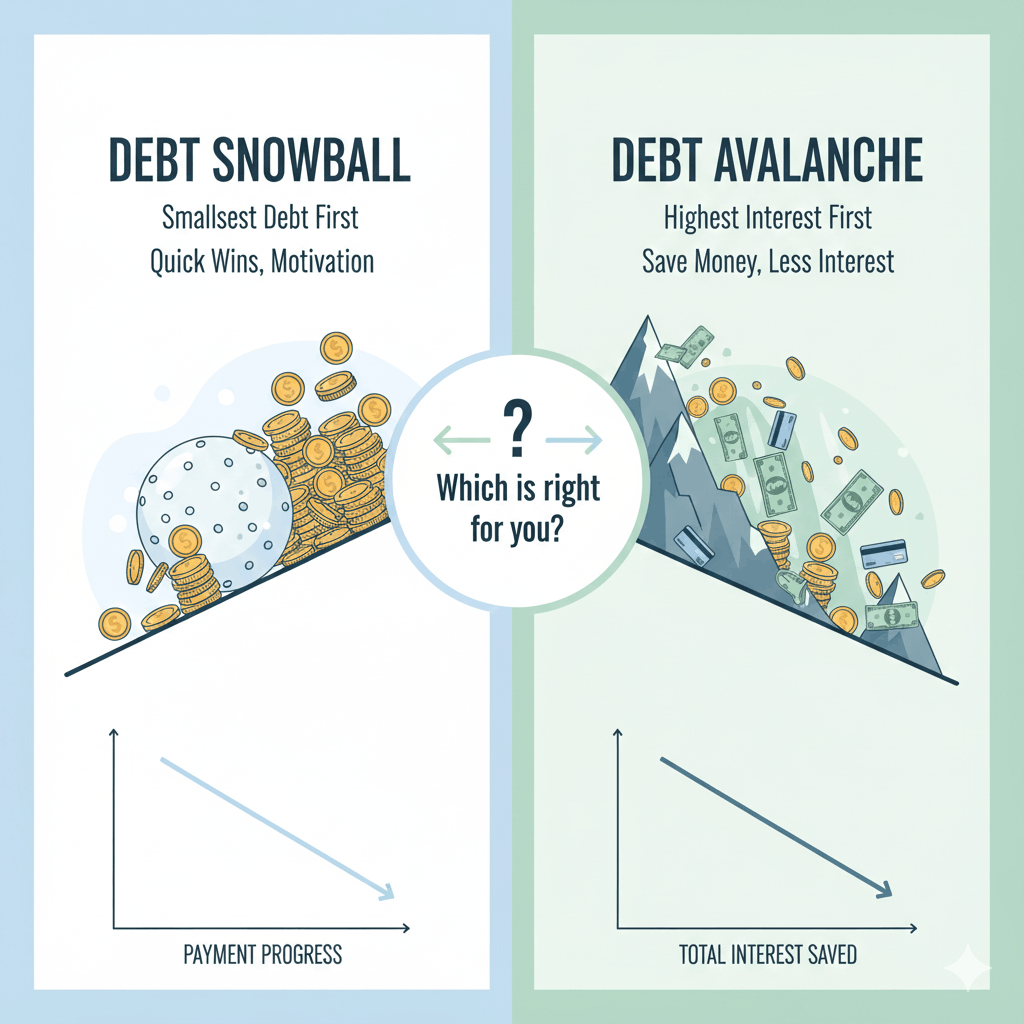
This guide breaks down the debt snowball method and the debt avalanche method in plain language, then walks you through a step by step debt payoff plan you can start today. You will also see how to choose the best debt repayment strategy for your personality, your debt types, and your budget.
Quick definitions you can repeat in one sentence
Debt snowball method explained
The debt snowball method has you list debts from the smallest balance to the largest balance. You keep minimum payments on everything, then put your extra money toward the smallest balance first. Once that account is paid off, you roll that freed payment into the next smallest balance. The wins stack up fast, which can help motivation in debt repayment.
Avalanche method explained
The debt avalanche method has you list debts from the highest interest rate to the lowest interest rate. You keep minimum payments on everything, then put your extra money toward the highest interest debt payoff first. When that balance is gone, you move to the next highest interest rate. This approach often produces interest savings debt avalanche fans love, since it attacks the most expensive debt first.
Snowball vs avalanche debt payoff in one line
Snowball is built for quick wins. Avalanche is built for interest savings. The best debt repayment strategy is the one you will follow with debt payoff discipline until the last account is paid.
Why this choice matters more than people think
High-interest debt is not a small problem. Credit card rates are still painfully high. A Federal Reserve series shows credit card plan interest around 20.97% in November 2025. That single number explains why many people feel stuck even while paying every month.
Revolving balances are also enormous. A FRED series tied to Federal Reserve consumer credit data shows revolving consumer credit around 1,313,920.25 million dollars (about 1.314 trillion) for November 2025. When a huge share of debt carries high interest, payoff order matters.
Still, math is not the only factor. Behavioral finance debt payoff research has shown that many people gravitate to paying off small balances first, even when it is not the cheapest approach. A Journal of Marketing Research paper describes “debt account aversion,” where people prefer wiping out small accounts because it reduces the number of open balances and feels like progress. That insight is useful, not embarrassing. It explains why snowball vs avalanche motivation is a real decision point.
The shared foundation that makes both plans work
Before you pick a method, build the base. This is the personal finance debt management part most people skip, and it is why plans break apart.
Step 1: Make a clean debt list
Write down every balance and include:
- Current balance
- Interest rate or APR
- Minimum monthly payment
- Due date
- Type of debt (credit card, student loan, auto loan, personal loan)
This becomes your debt payoff strategies comparison tool. Without it, you are guessing.
Step 2: Decide your monthly “extra”
Your plan needs a single number: how much you can put toward debt beyond minimum payments. This is your engine. Even a small amount works, as long as it is steady.
If your budget is tight, focus on budgeting for debt payoff by finding one realistic expense you can cut or pause. A plan that starves your life often collapses. A plan that you can live with tends to last.
Step 3: Protect the plan from new debt
Snowball method pros and cons and avalanche method pros and cons both change when you keep borrowing. If you are still using credit cards daily while paying down balances, you are driving with the brakes on.
A simple guardrail:
- Use debit or cash for daily spending
- Keep credit cards out of reach
- Pause new subscriptions
- Keep a small buffer for emergencies, even if it is modest
Step 4: Automate minimum payments
Missed payments can add fees and damage your progress. Put minimum payments on autopay if you can. Then focus your energy on the one targeted debt.
Debt snowball method: how it works in real life
The debt snowball method is often described as “smallest balance first,” though the real value is what happens after the first payoff.
Why the snowball creates momentum
When you pay off a small balance, you get three benefits:
- One less bill and one less due date to track
- A psychological win that strengthens debt payoff mindset
- A payment that can roll into the next debt, increasing your monthly firepower
This is the psychological benefits of debt snowball. It is not magic. It is feedback. Your brain sees proof that your actions matter.
Behavioral research supports this pattern. The debt account aversion work shows people feel relief when the number of open accounts drops, not only when total dollars drop. That relief can fuel the next month, which is where many plans fail.
Snowball method step-by-step debt payoff plan
Set your order
Sort debts by balance from smallest to largest. Ignore the interest rate for ordering. Keep the rates written down, because you still want to watch expensive debt.
Pay minimums on everything
Minimum payments keep accounts in good standing while you focus your extra cash.
Attack the smallest balance
Put every extra dollar toward the smallest balance until it is gone.
Roll the payment forward
When the smallest balance hits zero, add its old payment to your next target. This is the “snowball” effect. Your monthly payment power grows even if your income stays the same.
When snowball tends to shine
Snowball vs avalanche motivation is the deciding factor for many people. Snowball often fits best when:
- You feel overwhelmed by many accounts
- You need fast visible progress to keep going
- Your debt list has several small balances
- You have tried a “math-first” plan before and quit
Snowball method pros and cons
Snowball method pros and cons deserve honest treatment.
Pros:
- Faster early wins
- Simpler tracking
- Fewer open accounts sooner
- Strong for debt payoff discipline if motivation is the main barrier
Cons:
- It can cost more interest than avalanche when high APR debt sits untouched longer
- Your most expensive debt might stay expensive for longer
If your biggest debts are also your highest interest debts, snowball can feel slow after the early wins. That is where some people switch methods or use a hybrid plan.
Debt avalanche method: why the math usually wins
The debt avalanche method is built around high interest debt payoff. It usually reduces the total interest you pay because it attacks the most expensive rate first.
Why avalanche often saves more money
Interest is a cost that stacks every month. Paying down the highest APR debt first reduces how much interest can accumulate over time. That is the mathematical advantage of debt avalanche and the reason avalanche often delivers snowball vs avalanche interest savings.
This matters even more when credit card interest is around 20% in today’s market. If your highest APR card is draining you monthly, hitting it first often shortens your payoff timeline or lowers total interest paid.
Avalanche method step-by-step
Set your order
Sort debts from highest interest rate to lowest interest rate. If two debts share the same rate, target the smaller balance first so you can get an early win without breaking the logic.
Pay minimums on everything
Minimum payments keep you current and prevent late fees.
Attack the highest interest debt
Put all extra cash toward that top-rate debt until it is gone.
Roll the payment forward
When the highest rate debt is finished, move your full payment amount to the next highest rate.
When avalanche tends to shine
Avalanche is often a strong choice when:
- Your biggest balances are also high interest
- You can stay steady even without quick wins
- You are motivated by numbers and progress charts
- Your goal is interest savings debt avalanche style, even if the first payoff takes time
Avalanche method pros and cons
Pros:
- Often lower total interest costs
- Often faster overall payoff when rates are high
- Clear logic that is easy to justify
Cons:
- Your first payoff may take longer, which can hurt momentum
- If motivation is fragile, you may quit before the method pays off
A realistic example: same debts, different results
Examples make the debt payoff strategies comparison feel real.
Imagine you have three debts and you can pay $250 extra per month beyond minimums.
- Card A: $500 balance at 18% APR
- Card B: $2,500 balance at 29% APR
- Loan C: $3,000 balance at 10% APR
Snowball vs avalanche payoff order strategy
Snowball targets Card A first because it is the smallest balance. That gives a fast win, reduces one bill quickly, and builds motivation in debt repayment. After Card A is paid, you roll its payment into the next smallest balance.
Avalanche targets Card B first because it is the highest APR. The early months may feel slow, yet your extra payments are cutting the most expensive interest.
What changes between the two
- Snowball often reaches the first “paid off” moment faster
- Avalanche often produces stronger interest savings debt avalanche results, especially with high APR balances
- The fastest way to get out of debt depends on which method you can follow without stopping
A perfect plan that you abandon is not better than a slightly more expensive plan you finish. That is the hidden truth behind which debt payoff method is better.
Which debt payoff method is better for you
You do not need a personality test. You need honesty about how you act when progress feels slow.
Pick snowball if motivation is your biggest obstacle
Snowball is often best when:
- You need visible progress soon
- You feel stress from juggling many accounts
- Your debt payoff mindset improves with small wins
- You want a plan that feels lighter quickly
This is where psychological benefits of debt snowball can keep you moving when life gets loud.
Pick avalanche if interest savings is your biggest goal
Avalanche is often best when:
- High interest debt payoff is draining your budget each month
- You can handle a slow first payoff
- You enjoy tracking numbers and total interest estimates
- You want the payoff plan that often costs less overall
With credit card rates around 20% on average in recent data, the interest angle matters more than many people realize.
Pick a hybrid if you want momentum and math
Many people do a hybrid without naming it:
- Pay off one tiny balance first to get breathing room
- Switch to avalanche for the rest, focusing on the highest APR
This can balance snowball vs avalanche motivation with interest savings debt avalanche logic.
Applying snowball and avalanche to different debt types
Not all debt behaves the same in a real budget.
Credit card debt payoff methods
Credit cards often carry the highest rates, so avalanche can be powerful. Still, if you have multiple small cards, snowball can quickly reduce the number of bills and lower mental load.
One practical approach:
- If you have one extremely high APR card, place it early in your plan even if it is not the smallest balance
- If you have many small cards and one big card, snowball can clear the small ones first, then shift focus to the big one
Student loan repayment strategies
Student loan repayment strategies vary by loan type and rate. If your loans have lower rates and fixed payments, they may not be the best first target if credit cards are charging much more. In many debt reduction strategies, credit card payoff comes before lower-rate loans.
Still, if a student loan is past due or in trouble, that changes the priority. Protect your standing first, then return to payoff order.
Low balance debt payoff vs high interest debt payoff
Low balance debt payoff helps momentum. High interest debt payoff helps cost. Both are valid goals. Your situation decides which one needs attention first.
Budgeting for debt payoff without burning out
People fail plans because they try to change everything at once. Budgeting for debt payoff works better when it is simple and repeatable.
Build a budget that supports your plan
Start with three numbers:
- Income after tax
- Fixed bills
- Variable spending
Your “extra” for debt comes from what is left. If nothing is left, you still have levers:
- Reduce one variable spending category for 30 days
- Pause optional subscriptions
- Sell unused items
- Add a small side income stream for a defined period
This is not about perfection. It is about building a long term debt repayment plan that your life can handle.
Debt payoff discipline without harsh rules
Debt payoff discipline comes from reducing decision fatigue:
- Automate minimum payments
- Pay extra on the same day each month
- Track balances once per month, not every day
- Celebrate milestones that are not shopping-based
Debt payoff timeline: how to set one you can follow
A debt payoff timeline should be realistic. If you set a timeline that demands extreme sacrifice, you may quit and lose months.
A better approach:
- Estimate a timeline with your current “extra”
- Try to improve it by small increases every few months
- Use windfalls (bonus, refund, gift money) as optional accelerators, not requirements
This supports credit card debt payoff methods and student loan repayment strategies without turning your life into a punishment.
Debt payoff calculator comparison: what to look for
A debt payoff calculator comparison can be helpful, yet calculators only work if your inputs reflect real behavior.
When you compare snowball vs avalanche interest savings, check:
- Whether the calculator assumes you stop using credit during payoff
- Whether it uses real APRs and minimum payments
- Whether it lets you add one-time extra payments (windfalls)
- Whether it shows time to first payoff, not only final payoff
Time to first payoff matters for snowball vs avalanche motivation. Total interest matters for math. Both numbers are worth seeing.
Debt consolidation vs snowball and avalanche
Debt consolidation vs snowball and debt consolidation vs avalanche is not an either-or. Consolidation changes the interest structure. Snowball and avalanche change the payment order.
When consolidation can help
Consolidation can help when it lowers your interest rate and simplifies payments. It can also help when your credit cards have very high APRs and you can qualify for a lower-rate product.
Where people get burned
Consolidation can fail when:
- Fees are high
- The rate is not much better
- People keep using old credit lines and end up with new debt on top of the consolidated balance
How snowball and avalanche still apply after consolidation
If you consolidate some debts into one loan, you still may have other debts left. You can still use the debt payoff order strategy on what remains. Even with one big consolidation loan, you can use a plan for any remaining balances.
Common mistakes that slow both methods
These mistakes show up in every debt payoff story.
Paying extra without changing spending
If you keep adding new charges while paying down balances, the plan becomes a treadmill. Both snowball and avalanche struggle under that weight.
Ignoring the first month
The first month often sets the pattern. Many people plan for weeks and never start. Pick a date, set autopay, make the first extra payment, and let momentum build from action.
Chasing perfection
A debt plan does not need a flawless budget. It needs consistency. Missing one month does not ruin your plan. Restart the next month and keep the chain going.
Letting the plan live only in your head
Write it down. Put it in a note, a spreadsheet, or a paper tracker. Seeing it turns it into a system, not a wish.
Conclusion
Debt snowball vs debt avalanche is not a debate you “win.” It is a choice you live with for months. The debt snowball method often fits people who need quick wins and fewer open accounts to stay motivated. The debt avalanche method often fits people who want to reduce interest costs and can tolerate slower early payoff. Credit card rates remain high, and revolving balances remain massive, so payoff order matters. Choose the method that matches your behavior, then stay consistent until you are done.


