
Debt Consolidation: Pros, Cons, and What to Watch Out For
Debt can feel noisy. Multiple due dates, different interest rates, and balances that barely move when you pay the minimum. That’s the moment many people start searching Debt Consolidation Pros Cons because they want a clean answer: will combining debts make life easier, or will it create new problems?
Debt consolidation can be a solid move for the right person. It can cut interest, simplify payments, and help you stop falling behind. It can just as easily backfire if the numbers do not work, the fees eat the savings, or the plan lowers your payment but stretches the debt for years.
This guide breaks down debt consolidation explained in plain terms, then walks through debt consolidation advantages, debt consolidation disadvantages, the risks of debt consolidation, and the debt consolidation mistakes to avoid. You will see the differences between a consolidation loan, a balance transfer, and a program. You will get a decision path you can follow without guessing.
Numbers that frame the decision
Debt consolidation lives in the real world, so it helps to see what the real world looks like.
Credit cards remain one of the costliest forms of borrowing for many households. The commercial bank interest rate on credit card plans (all accounts) was 20.97% in November 2025, based on Federal Reserve data published through FRED.
Total household debt reached $18.59 trillion in Q3 2025, according to the New York Fed’s Quarterly Report on Household Debt and Credit.
Credit card balances stood at $1.23 trillion in Q3 2025, with the New York Fed noting an increase during the quarter and a year-over-year rise.
Fees matter, too. The CFPB has reported that credit card late fees grew into a major cost for consumers, reaching over $14 billion in 2022.
On the consolidation-loan side, borrower rates vary widely, though consumer rate trackers often show an average around the low teens for borrowers with decent credit. Bankrate reported an average personal loan rate of 12.19% for a 700 FICO profile (as of Jan. 14, 2026) in its monitoring data.
These numbers do not mean debt consolidation is always right. They explain why the idea keeps coming up. When credit cards sit near 20% APR, even a “normal” personal loan rate can create real savings.
Debt consolidation explained (and what it is not)
Debt consolidation is the act of combining multiple debts into one payment. Most people do this in one of three ways:
A debt consolidation loan that pays off several balances and leaves you with one installment loan.
A balance transfer credit card that moves credit card debt to a new card, often with a promotional rate.
A program that bundles payments into one structured plan, usually with some form of counseling or servicing.
What debt consolidation is not: it is not debt settlement. Debt settlement tries to negotiate the balance down, usually after you stop paying, and it can bring serious credit damage and collection pressure. That comparison is a common search: debt consolidation vs debt settlement. Consolidation aims to repay what you owe on a cleaner schedule. Settlement aims to pay less than owed, often after default.
Debt consolidation is not the same as a debt management plan either, even though people mix the terms. Debt management vs consolidation usually comes down to who holds the loan. In many debt management plans, you are not getting a new loan. Instead, you make one payment to an agency, and the agency pays creditors based on a set plan. Consolidation often means a new loan or new credit line that replaces old balances.
Debt consolidation vs credit counseling is another common comparison. Credit counseling can exist without consolidation. Counseling is guidance, budget work, and negotiation help. Consolidation is a financial product or structure.
Why consolidation feels appealing
One reason is emotional. Multiple minimum payments create constant pressure. A single monthly payment can feel calmer.
Another reason is math. If most of your debt is high-interest debt, moving it to a lower rate can reduce the amount of money lost to interest each month. That creates debt consolidation savings potential.
A third reason is control. Many people miss payments because of calendar chaos, not because they refuse to pay. Consolidation can reduce the chance of a missed payment by reducing the moving parts.
Still, the same features that make it attractive can create debt consolidation pitfalls. A lower monthly payment can hide a longer payoff timeline. A fresh credit line can tempt new spending. Some lenders add fees that erase your savings.
So the real question is not “Is consolidation good?” It is “Does this consolidation plan create savings, reduce risk, and fit your behavior?”
Debt Consolidation Pros Cons analysis that helps you decide
Debt consolidation pros and cons often get presented as a simple list. The list matters, but the real value is knowing when each point applies to you.
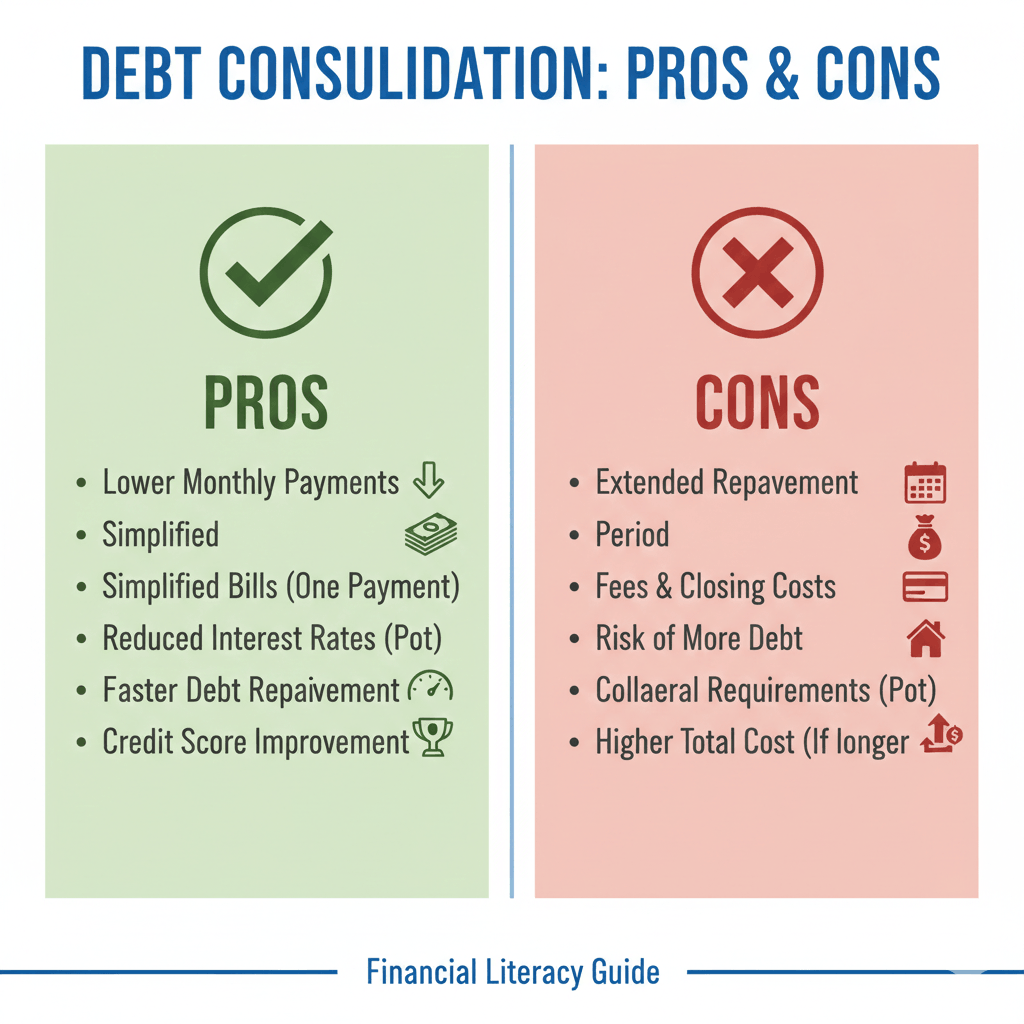
The pros of consolidating debt
Debt consolidation advantages usually fall into a few buckets.
One payment and fewer due dates
This is the most visible benefit. Consolidation of multiple debts can make your budget easier to run. If you tend to miss due dates, one payment can reduce late fees and reduce stress. When late fees and interest are already expensive in the market, stopping preventable fees can matter a lot.
Lower interest costs for some borrowers
If your current balances are on credit cards and you qualify for a lower rate, the interest savings can be meaningful. With credit card interest rates near 20% in recent Federal Reserve data, even a mid-teen personal loan can save money over time, assuming fees and term length stay reasonable.
Debt consolidation for high-interest debt is where consolidation often shines. The bigger the interest gap, the bigger the potential savings.
A clearer payoff schedule
Credit cards can keep you in a loop. Minimum payments are designed to stretch over long periods. Installment loans tend to have a fixed end date. If you keep the same payoff pace, consolidation can convert messy revolving debt into a plan with a finish line.
Possible credit score benefits in the right setup
Debt consolidation benefits for credit can happen, but it depends on what changes after the consolidation.
If you pay off high balances on revolving accounts and keep those cards open, your revolving utilization can drop. That can help your score.
If you stop missing payments, your payment history can improve over time.
If you reduce the number of accounts with balances, your credit profile may look less strained.
Still, none of that is automatic. A consolidation loan does not magically repair credit. It creates an opportunity to behave in a score-friendly way.
The cons of consolidating debt
Debt consolidation disadvantages tend to show up when the plan is chosen for convenience rather than total cost.
Fees can wipe out savings
Debt consolidation fees are common. Personal loans can have origination fees. Balance transfers often carry a transfer fee. The CFPB has stated that balance transfer fees can be charged even on a 0% offer.
A fee does not automatically make consolidation bad. It means you should calculate break-even. If the fee costs $300 and the new interest rate saves $50 a month, the fee is paid back in six months. If the savings are $10 a month, the fee becomes a problem.
A longer payoff term can raise the total cost
A lower payment can feel like relief. That relief can be expensive if the term doubles. A five-year loan can turn what could have been a two-year push into a long drag. That is one of the most common disadvantages of combining debts: the debt feels easier, so it sticks around longer.
New borrowing becomes easier
Many people consolidate credit card debt with a personal loan, then start using the credit cards again. Now they have the loan and new card balances. That is a classic debt consolidation pitfall. It is not a lender issue. It is a behavior issue that the plan must address.
Approval and pricing risk
Debt consolidation eligibility criteria can be strict for borrowers with weak credit. Some borrowers only qualify for high rates that do not save money. Some loans come with prepayment penalties or conditions that make the deal less flexible.
This creates a central reality of Debt Consolidation Pros Cons: the same plan can be a win for one person and a trap for another.
Types of consolidation (compare options without confusion)
Debt consolidation is not one product. It is a category. Most people land in one of these paths.
Debt consolidation loans
This is the most common path for people who want one monthly payment.
A lender gives you a personal loan. You use it to pay off your credit card balances and any other eligible debts. Now you have one installment loan payment.
This category includes pros and cons of debt consolidation loans and pros and cons of personal loans for debt.
How the loan option works in real life
You apply. The lender checks your credit and income. If approved, you receive a lump sum or the lender pays creditors directly. You then make fixed monthly payments.
Loans can work well when:
Your credit qualifies you for a rate meaningfully below your credit cards.
Your total payoff horizon is not stretched too far.
The monthly payment fits your cash flow without relying on future raises.
Interest rates: what people miss
Debt consolidation interest rates can look simple, but they hide a spread. Many lenders price based on credit profile, income, and term length.
Rate trackers can provide context. Bankrate’s monitored average for a borrower around 700 FICO was 12.19% (as of Jan. 14, 2026).
That number is not a promise. It is a reference point. Some borrowers see much lower. Some see much higher.
Repayment options and structure
Debt consolidation repayment options matter more than the headline APR.
Fixed-rate vs variable-rate terms change risk.
Term length changes total interest.
Auto-pay discounts can reduce cost.
Prepayment flexibility helps you pay faster in strong months.
Fees and hidden cost centers
Debt consolidation fees on loans can include:
Origination fees
Late fees
Optional insurance add-ons
Check processing fees in some cases
Fees are not automatically bad. They must be included in the total cost calculation.
Debt consolidation lender comparison: what to compare
When comparing lenders, a simple checklist can keep you safe.
APR and whether it is fixed
Origination fee and how it is charged
Term length options
Prepayment policy
Funding speed and whether creditors are paid directly
Customer support and payment tools
This is where “debt consolidation loan reviews” can help, not for hype, but for practical details like payment handling and fee policies.
Debt consolidation vs balance transfer
A balance transfer moves credit card debt to a new card, sometimes with a 0% promotional period. This is often treated as the “cheapest” option on paper.
The catch: balance transfer fees are common, and the rate after the promo period can jump sharply if the balance remains. The CFPB has been clear that a balance transfer fee can be charged on a zero percent offer.
Balance transfers tend to work best when:
Your debt is not too large to fit on the new credit line.
You can pay most or all of it during the promo window.
You can avoid new spending on the card carrying the transfer.
Debt consolidation vs balance transfer becomes a math problem and a behavior problem.
If you can pay it off fast, balance transfers can be strong.
If you need years, a loan with a stable rate may be safer.
Programs and structured plans
Some people use a program rather than a new loan. This often shows up under “debt consolidation programs,” “debt management,” or counseling-based repayment plans.
Pros of debt consolidation programs can include:
A structured plan with a single payment
Possible creditor concessions arranged through the program
Support and budgeting tools
Cons of debt consolidation programs can include:
Fees charged by the program
Account closures in some plans, which can affect credit use patterns
Less flexibility compared to a personal loan
This is where debt management vs consolidation matters. In many programs, you are not taking on a new loan. You are changing how payments are routed and sometimes changing terms with creditors.
Government-backed consolidation (when relevant)
People search pros cons of government-backed consolidation because they expect a special loan that replaces all consumer debt. In practice, government-backed consolidation is more common in student loan contexts, not general credit card debt.
If you see claims of guaranteed government consolidation for credit cards, treat that as a warning sign. The details matter. The lack of details matters even more.
What to watch out for before you sign
Debt consolidation can fail in predictable ways. Avoiding those failures often matters more than chasing the lowest rate.
Debt consolidation mistakes to avoid
Choosing based on monthly payment alone
A lower payment feels like relief. It can create higher total cost if the term stretches too far. Always check total repayment cost across the full term.
Ignoring fees
Debt consolidation fees and balance transfer fees can wipe out savings. Include fees in your break-even math.
Consolidating and then adding new debt
This is the classic trap. If you consolidate credit card debt with a loan and keep spending on cards, the plan collapses. Set a rule before you consolidate: no new revolving balances until the loan is under control.
Skipping a budget reset
Consolidation is a structure change. If the overspending or cash flow problem remains, the debt returns. Even a simple reset helps: list fixed bills, minimum debt payments, and the amount left. If the amount left is negative, consolidation does not fix that by itself.
Falling for vague promises
Be cautious with lenders or companies that promise guaranteed approval, instant score jumps, or “special programs” without clear terms. Real consolidation is boring: rate, fee, term, monthly payment, total cost.
Credit score effects: what changes and why
Debt consolidation impact on credit score is one of the most searched topics in this niche. The answer depends on the type of consolidation and what you do after.
Short-term changes
When you apply for a loan or a new credit card, the lender may do a hard inquiry. That can cause a small, temporary dip for some people.
If you take a personal loan, you add a new installment account. The mix of credit types can shift.
If you pay off credit card balances, your revolving utilization can drop. That can help scores quickly in many cases.
So debt consolidation credit score effect in the short term can be mixed: small dip from inquiry, potential lift from lower utilization.
Longer-term effects
The longer-term effects tie to behavior.
On-time payments on the new consolidated account support a positive payment record over time.
Keeping old credit cards open with low balances can help maintain available credit and utilization.
Missing payments on the new loan can be worse than missing a small minimum payment on one card, since you now have one large obligation.
Debt consolidation long-term effects often look positive when the borrower uses consolidation to stop missed payments and reduce revolving debt pressure. When the borrower uses consolidation as room to borrow more, the score trend can turn negative.
Debt consolidation vs debt settlement, debt management, and credit counseling
People often land on consolidation after hearing about other routes. It helps to see the trade-offs clearly.
Debt consolidation vs debt settlement
Debt settlement attempts to pay less than owed, often after you stop paying. That can trigger late marks, collection activity, and potential legal risk. Settlement can be a last-resort option for some people in severe hardship, yet it tends to carry heavier credit impact.
Debt consolidation repays what you owe on a new schedule. It can still be hard, but the credit impact can be far less damaging when payments stay on time.
Debt management vs consolidation
Debt management plans can lower interest rates through negotiated arrangements in some cases. They may require closing cards. They may charge fees. They can be useful for people who struggle with self-management and want structure.
Consolidation loans can be more flexible but require discipline.
Debt consolidation vs credit counseling
Credit counseling can be helpful even if you do not consolidate. Counseling can help you build a workable budget and choose between options without pressure.
A decision framework you can follow
Debt Consolidation Pros Cons becomes easier when you treat it as a screening process.
Step 1: Know what you are consolidating
List each debt:
Balance
APR
Minimum payment
Due date
Type (credit card, personal loan, store card)
This clarifies whether you are dealing with mostly revolving credit, mostly installment loans, or a mix.
Step 2: Decide what “better” means for you
Some people want the lowest total cost.
Some people want fewer payments and less missed-payment risk.
Some people need the lowest monthly payment to stay current.
Write down your priority. This will shape your choice.
Step 3: Compare options using total cost, not marketing
For each option, calculate:
Upfront fees
New APR
Monthly payment
Term length
Total paid over the term
If you cannot get the total paid number, the comparison is incomplete.
Step 4: Add behavior rules before you sign
Consolidation works better with rules like:
Do not use credit cards for new purchases until the consolidated balance is under control.
Set auto-pay for at least the minimum.
Build a small buffer fund to avoid missing payments after a surprise expense.
These rules are not motivational slogans. They reduce failure risk.
Step 5: Make the call
A quick way to decide:
Consolidation is often a yes when the new rate plus fees creates meaningful savings, the term does not stretch too far, and the payment fits your budget without relying on luck.
Consolidation is often a no when the new rate is close to current rates, fees are high, the term stretches too long, or spending habits are not addressed.
Quick checklist for lender shopping
Debt consolidation lender comparison can feel messy. This short checklist keeps it clean.
APR and whether it is fixed
Total fees and when they are charged
Term length and total cost across the term
Payment flexibility and prepayment policy
What happens on late payments
Whether creditors are paid directly or you receive the funds
Customer support and account tools
This checklist is simple by design. A good loan should survive simple scrutiny.
Realistic expectations about outcomes
Debt consolidation outcomes usually fall into three patterns.
Good outcome
The borrower consolidates to a lower rate, keeps the payoff term reasonable, and stops new revolving balances. They pay on time. The debt shrinks. Stress decreases. Credit can improve as utilization drops and payment history stays clean.
This is where debt consolidation plan effectiveness shows up.
Average outcome
The borrower consolidates and gets a small interest benefit, yet the term is long. The debt still gets paid off, but it takes time. The plan works, just slowly.
Bad outcome
The borrower consolidates, then starts using cards again. The debt grows. Payment strain returns. This is the most common failure story, and it usually traces back to one of the debt consolidation mistakes to avoid listed earlier.
When people ask about debt consolidation success rates, the honest answer is that success depends more on structure plus behavior than on the product type alone. A great rate cannot fix repeated new borrowing. A “just okay” rate can still lead to success when spending stops and payments stay on track.
Debt consolidation expert tips that stay practical
Keep the plan boring. Boring plans get paid.
Treat fees as part of your rate. A loan with a lower APR can be more expensive when fees are high.
Avoid stacking products. One clean consolidation is easier than a loan plus a new balance transfer plus a second card.
Track the payoff monthly. A simple note with your balance each month can keep you grounded.
Do not chase perfection. A workable plan today beats a “perfect plan” you never start.
Conclusion
Debt consolidation can be a strong tool when it lowers total cost, simplifies payments, and fits your real budget. The same move can become a trap when fees wipe out savings, the term stretches too far, or new card spending returns. If you treat Debt Consolidation Pros Cons as a screening process—total cost, term length, fee impact, and behavior rules—you can choose with clarity and avoid the most common pitfalls.


