

Wire Transfer vs ACH: Fees, Speed, and When to Use Each
Money moves in two main “bank to bank transfer” lanes in the U.S.: the wire transfer lane and the ACH transfer lane. Both are electronic funds transfer options, both can look similar inside a banking app, and both can deliver money to another person or business. The difference shows up when the payment is urgent, large, tied to a deadline, or needs a clear paper trail.
This guide breaks down Wire Transfer vs ACH in plain language: how each payment rail works, what fees look like in real life, what “same day” really means, where cutoff times matter, how tracking works, what happens when something goes wrong, and which method fits common situations like payroll ACH, vendor payments, rent, real estate closings, and international wire transfer needs.
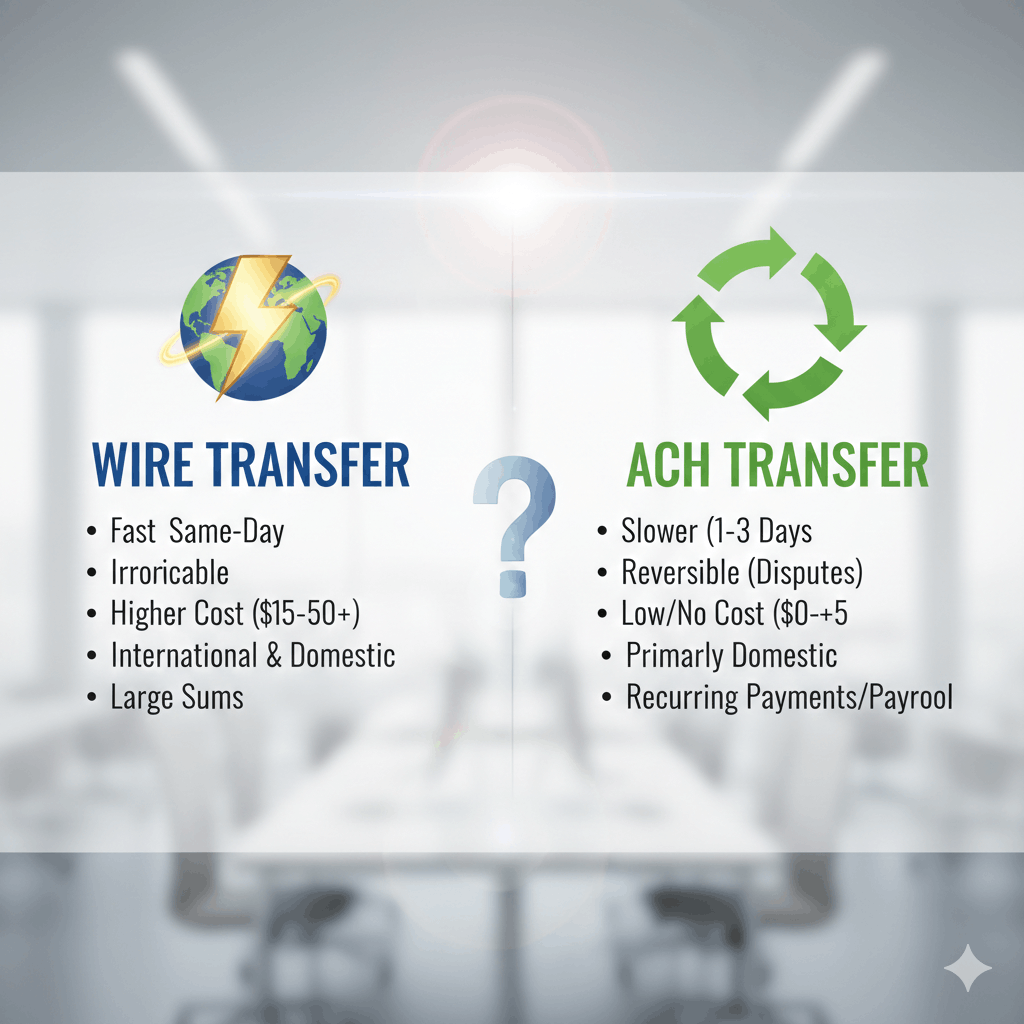
Wire Transfer vs ACH at a glance
Wire Transfer vs ACH is a tradeoff between speed, cost, and how “final” the payment is.
A wire transfer (often called a bank wire transfer) is built for fast settlement and time-sensitive transfers. It is commonly used for one time wire transfer payments, large transactions, and situations where the recipient needs funds credited quickly. Wires usually come with wire transfer fees.
An ACH transfer (often written as ach transfer) is built for high-volume payments and everyday money movement. It is widely used for ach payment flows like direct deposit, recurring ACH payments, bill pay, and business payments. ACH is often low cost or even free for many consumers, though businesses may face ACH fees through their bank or payment processor.
If you are making a decision fast, a simple way to frame Wire Transfer vs ACH is this:
- Choose wire transfer when time is tight, the amount is large, or the recipient requires it.
- Choose ACH transfer when cost matters, the payment can clear in one to three business days, or the payment repeats.
The rest of this article gives you the details you need to pick the best bank transfer method for the moment you’re in.
What an ACH transfer is
An ACH transfer is a bank to bank transfer that runs through the Automated Clearing House network. You will see the phrase automated clearing house in bank help centers, payroll forms, and vendor payment portals.
ACH is a bank clearing system designed to move large volumes of payments efficiently. Instead of settling each transaction instantly one by one, ACH commonly groups transactions into batches and processes them during scheduled windows. That batching is one reason ACH is usually cheaper than a wire transfer. It is also one reason ach processing time is not always immediate.
ACH sits under the umbrella of electronic payment methods. People may call it an EFT payment (electronic funds transfer) since it is money moved electronically.
ACH credit vs ACH debit
ACH comes in two common directions: ach credit and ach debit.
ACH credit is a “push” payment. The sender initiates the payment and sends money out. Payroll ACH direct deposit is a classic ach credit. A business sending vendor payments through ACH credit is another.
ACH debit is a “pull” payment. The sender (often a biller) pulls funds from a payer’s account after authorization. Utility bills, subscription payments, and some rent systems use ach debit. That is where ach authorization becomes a key step. A payer signs an authorization that allows the biller to debit the account.
This difference matters in Wire Transfer vs ACH because it affects controls, returns, and the way disputes work.
Same Day ACH and what it changes
Same day ACH is a faster version of ACH processing. In the U.S., Same Day ACH processes multiple times per business day, and it can move money in a matter of hours when the entry is submitted before the receiving windows. The current Same Day ACH per-payment limit is up to $1 million, which made it useful for larger domestic payments that once defaulted to wires.
Same day ACH does not mean instant money movement the way a card swipe feels instant. It means faster ACH settlement time compared with standard ACH.
ACH processing time in real life
Standard ACH processing time is commonly described as one to three business days. The exact timeline depends on your bank, the type of payment (ach credit vs ach debit), and when the payment was submitted relative to your bank’s ach cutoff time. A payment submitted after cutoff may not enter the next processing window until the following business day.
This is a practical detail in Wire Transfer vs ACH decisions. If you have a payment deadline tomorrow morning, a standard ACH transfer may not be the right pick.
What a wire transfer is
A wire transfer is a direct bank to bank transfer that settles through wire networks rather than ACH. In the U.S., domestic wire transfer payments commonly travel through Fedwire transfer rails. International wire transfer payments often travel through SWIFT wire transfer messaging, sometimes involving correspondent banking.
People use wire transfer for urgent domestic payments, large purchases, and transactions where settlement finality matters. Many real estate down payments, escrow funding, and certain business purchases still ask for a bank wire transfer.
Fedwire transfer and wire transfer settlement
Fedwire is the core domestic wire rail used by banks in the U.S. A key difference in Wire Transfer vs ACH is settlement style:
- Wire transfer settlement is processed individually and credited quickly once accepted and sent.
- ACH settlement time relies on processing windows and bank posting cycles.
Wire transfer speed can be fast, yet it is still governed by banking hours, fraud checks, and wire transfer cutoff time at the sending bank.
A helpful detail for timing: Fedwire’s operating day spans from 9:00 p.m. Eastern Time on the prior calendar day through 7:00 p.m. Eastern Time on business days. Banks often set their own earlier internal cutoffs for customers, and third-party wire deadlines can come earlier than the network close. This is why “send it early” is repeated so often in wire instructions.
Domestic wire transfer vs international wire transfer
Domestic wire transfer payments usually stay within one country’s banking system. Many can arrive the same business day when sent before internal cutoffs.
International wire transfer payments are cross border payments. They may move across multiple banks through correspondent banking relationships. That extra path can add time, fees, and complexity. Even when wire transfer speed is still fairly quick, international transfers can take longer than domestic wires.
In Wire Transfer vs ACH comparisons, a key point is that ACH is mainly used for domestic payments within the U.S. International payments are usually not handled by ACH in the same way.
Wire Transfer vs ACH fees and costs
Fees are one of the first questions people ask in Wire Transfer vs ACH decisions.
Wire transfer fees are common. Many banks charge a wire transfer cost for outgoing wires, and some charge for incoming wires too. Typical ranges vary by institution. A widely cited benchmark is that domestic outgoing wire fees average around the high twenties in U.S. dollars, and outgoing international wire fees average in the mid-forties. You will still see outliers: some banks price lower for premium accounts, some charge more when the wire is initiated in a branch, and some charge extra for international wires.
ACH fees are often lower. Many consumer banks offer ach transfer services with no fee, especially for standard transfers between your own accounts or to other people using bank transfer features. Business ACH can be priced per transaction, per batch, or through a monthly plan. So “ach cost” may look like pennies to a small dollar amount per payment in many business setups, then shift based on volume and risk controls.
When you compare wire transfer fees vs ach fees, add these cost details that people miss:
- Incoming wire charges can apply on top of outgoing wire charges.
- Intermediary banks can add fees for international wire transfer routes.
- Receiving banks can post “lift” fees in some cases.
- Some businesses pay ACH fees through their payment processor, even if the end customer sees “free.”
In short, Wire Transfer vs ACH cost differences can be large. If the payment is not urgent, ACH is often the low cost bank transfer option.
Wire Transfer vs ACH speed and cutoff times
Speed feels simple until you hit a deadline. This section covers transaction speed comparison without marketing language.
Wire transfer speed and wire transfer cutoff time
Domestic wire transfer can be very fast once processed. Many wires credit the recipient the same day. Still, the timing depends on:
- The sending bank’s wire transfer cutoff time
- Fraud checks and wire transfer verification steps
- Whether the wire is domestic or international
- Whether the receiving bank posts wires in real-time or in posting cycles
A wire transfer sent late in the day may not post until the next business day, even if it’s still processed inside the wire network on time. That is why wire instructions often stress the cutoff time.
ACH transfer speed and ach cutoff time
ACH transfer speed is slower in the standard lane. Typical guidance is one to three business days for standard ACH.
Same day ACH can move faster. It settles multiple times per business day, so it can reach a recipient in hours when submitted early enough and when the bank supports the needed processing path. Banks may still set earlier customer cutoffs than the network windows, so ach cutoff time remains important.
Real time payments and where they fit
Real time payments are another rail category that sits alongside Wire Transfer vs ACH. In the U.S., real-time rails like RTP and FedNow exist, and many banks are adding them to their money movement tools.
Real time payments can feel like instant bank to bank transfer, often 24/7. Yet availability depends on whether both banks are connected and whether your account is enabled for the feature. Fees and limits vary by bank.
This matters in Wire Transfer vs ACH decisions because some use cases that once needed a wire can now fit a faster ACH option or a real-time rail, depending on bank support.
Limits: wire transfer limits vs ach transfer limits
People often assume the network sets the limit. In practice, banks set many of the working limits.
Wire transfer limits can be high for verified customers, yet banks may limit wires per day, per transfer, or per recipient for fraud control. Businesses may have higher limits after underwriting, especially for vendor payments and B2B payments.
ACH transfer limits are often lower for consumers, then higher for businesses that process payroll ACH or recurring ACH payments. Some banks impose daily caps for consumer bank transfer activity to reduce fraud exposure.
Same day ACH has a per-payment limit up to $1 million at the network rule level, but your bank may set a lower cap for your account.
If your payment amount is large, Wire Transfer vs ACH may shift toward wire by default, then shift back toward same day ACH if your bank supports large same-day entries and your account limits allow it.
Tracking and proof: wire transfer tracking vs ACH trace number
When money doesn’t show up, the first question is “how do we track it?”
Wire transfer tracking
Wire transfer tracking often relies on confirmation details like reference numbers, confirmation pages, and bank records. Banks may provide a wire confirmation that shows the date, amount, recipient details, and a reference number tied to the fedwire transfer message.
For international wire transfer routes, tracking can be more complex when correspondent banking is involved, since the payment may pass through intermediary institutions.
ACH trace number and how it helps
ACH payments generate identifiers commonly referred to as an ach trace number. If a payment is missing, the trace number helps banks locate the transaction in the ACH stream. For businesses, this can be part of payment operations and reconciliation.
In Wire Transfer vs ACH troubleshooting, it’s useful to know what proof each method creates. Both create audit trails, but the identifiers and support steps differ.
Reversals, returns, and what happens after a mistake
Mistake recovery is one of the biggest differences in Wire Transfer vs ACH.
Wire transfer reversal and wire transfer refund realities
A wire transfer reversal can be difficult once the wire is sent and accepted. Wires are treated as final payments in many cases. Banks can request a recall, but success depends on timing and whether the recipient bank and recipient cooperate.
A wire transfer refund is often not a bank process. It is usually the recipient sending money back in a new transaction. If you sent a wire to the wrong place, the bank may not be able to pull it back.
This is why wire transfer verification matters so much.
ACH reversal rules and ACH return codes
ACH has a more structured return framework than wires. ACH reversal rules can allow for corrections under defined conditions, and ACH return codes exist to describe why a transaction was returned. Examples include insufficient funds, closed account, invalid account number, or unauthorized debit.
This does not mean ACH is easy to reverse at will. It means there is a more formal path for returns and exceptions.
In Wire Transfer vs ACH choices, the “undo” question is often a deciding factor. If you want a clearer dispute-and-return structure, ACH tends to provide more pathways than a wire transfer.
Security: wire transfer security vs ACH security
Security is not only about encryption or the banking app. It’s also about fraud patterns and how payments are verified.
Wire fraud risk and common attack patterns
Wire fraud risk is high in situations where criminals can trick someone into sending a wire. A common pattern is invoice fraud: a business receives an email that looks like a vendor request, but the bank details are swapped. Real estate scams can happen when closing instructions are intercepted or spoofed.
The reason wires are targeted is simple: money can move quickly, and reversal is hard.
Wire transfer verification steps that reduce risk
Wire transfer verification should be treated like a checklist, especially for large payments:
- Confirm wire instructions using a known phone number, not the one inside an email
- Verify the recipient name, bank routing details, and account number
- For business payments, use dual approval workflows
- Use recipient templates only after an out-of-band verification
- Be cautious with last-minute “bank detail change” requests
These steps are common in wire transfer compliance programs and internal controls for business payments.
ACH fraud protection and ach authorization controls
ACH security often leans on authorization controls. ACH debit requires authorization from the account holder, and banks and payment processors maintain risk rules around unauthorized debits. For recurring ACH payments, authorization records matter.
ACH fraud protection can still fail if credentials are compromised, yet ACH has more built-in return pathways than wires. That difference is one reason some businesses prefer ACH for recurring payments and reserve wire transfer for specific high-urgency cases.
Compliance and rules: NACHA regulations and wire transfer regulations
Both rails operate under rules and legal frameworks. You do not need to be a compliance expert to make everyday payments, but a basic understanding helps businesses avoid expensive errors.
ACH rules NACHA
NACHA rules govern ACH entries in the U.S. You may see the phrase ach rules naccha or naccha regulations in bank materials and payment processor documentation. These rules define formats, timing requirements, return timeframes, authorization standards, and risk requirements.
For businesses handling payroll ACH or large volumes of vendor payments, NACHA compliance is a real operational requirement. It affects onboarding, monitoring, and how disputes are handled.
Wire transfer compliance and wire transfer regulations
Wire transfer regulations and wire transfer compliance requirements are shaped by banking law, anti-money laundering expectations, sanctions screening, and bank policy. Banks often apply more scrutiny to wires than to standard ACH transfers, especially for large payments or unusual destinations.
International wires can trigger added controls, like screening for sanctioned parties and reviewing unusual payment patterns, which can affect wire transfer speed.
Wire Transfer vs ACH for business payments
Businesses run into Wire Transfer vs ACH decisions daily, especially in payables, payroll, and treasury operations.
Vendor payments and B2B payments
For vendor payments, ACH is often preferred when the vendor accepts it and when timing is predictable. ACH can lower transaction cost comparison results over time, especially at scale. Many B2B payments are scheduled, making the ACH lane a natural fit.
Wire transfer can be used for urgent vendor payments, first-time vendors that require wire, or high-value purchases where the vendor wants funds credited quickly.
Wire vs ACH for payroll
Wire vs ACH for payroll is usually not a close contest. Payroll ACH is common because it is built for high-volume, scheduled payments with predictable processing cycles. Same day ACH can help with payroll corrections when a mistake happens and the deadline is near.
Wire transfer is rarely used for standard payroll, though a business might use a one time wire transfer for an executive payment or a special case.
Payment processing methods inside modern banking tools
Many banks bundle payment processing methods into a single dashboard: wires, ACH, checks, and card payments. It can look like “online money transfer” options, but each choice still runs on a different rail.
This matters because the same screen can hide very different outcomes: fees, speed, reversal options, and reporting.
Wire Transfer vs ACH for everyday personal payments
Wire Transfer vs ACH is not only a business topic. Consumers face it when paying rent, sending money to family, or moving savings between banks.
Wire vs ACH for rent
Wire vs ACH for rent depends on the landlord’s setup. Many landlords and property managers use ACH debit or ACH credit through rent platforms. That supports recurring ACH payments and reduces bank transfer fees.
Wire transfer is less common for monthly rent, but it may show up for first-month move-in costs, deposits, or high-value leases. If a landlord asks for wire, treat wire transfer verification as non-negotiable. Scams exist in rental markets too.
Consumer bank transfer between your own accounts
Moving money between your own banks is often done via ACH transfer. Many consumer bank transfer tools use ACH as the default. If you see “external transfer” in an app, it is often ACH behind the scenes.
Same day ACH or real time payments may show up as optional speed upgrades in some banks.
Large one-time payments
Wire vs ACH for large payments often comes down to limits and deadlines. If you are sending a down payment, funding escrow, paying tuition, or completing a time-sensitive purchase, the recipient may demand a bank wire transfer.
If the payment can wait and the recipient accepts ACH, same day ACH may be a strong alternative when available and within limits.
Wire Transfer vs ACH for international payments
Wire vs ACH for international payments is usually straightforward: ACH is mainly domestic, and international payments typically use international wire transfer routes.
International wire transfer often travels via SWIFT wire transfer messaging. The funds can pass through correspondent banking, which can add:
- Time: sometimes multiple business days
- Fees: sending, receiving, intermediary deductions
- Complexity: currency conversion, bank compliance checks
If you need cross border payments frequently, consider whether your bank offers specialized international transfer services. The goal is still the same: secure money transfer with clear expectations.
Practical decision guide: choosing the right rail
This section turns Wire Transfer vs ACH into a simple decision pattern you can reuse.
Choose ACH transfer when
ACH transfer is a strong fit when the payment is not urgent to the hour and cost matters:
- recurring ACH payments like utilities, subscriptions, rent platforms
- payroll ACH and routine business payments
- vendor payments that follow net terms
- moving money between banks as a consumer bank transfer
- situations where a return framework is useful
Standard ACH processing time is commonly one to three business days. If that works, ACH is often the low cost bank transfer lane.
Choose wire transfer when
Wire transfer is a better fit when speed and confirmation matter more than cost:
- real estate closings, escrow funding, down payments
- large payments with strict deadlines
- urgent business purchases that need same-day credit
- recipients that require a domestic wire transfer
- many international wire transfer needs
Wire transfer speed can be fast, but the wire transfer cutoff time at your bank is the make-or-break detail.
Consider a faster alternative when your bank supports it
Sometimes the choice is not only wire transfer or ach transfer. Banks may offer:
- same day ACH for faster ACH settlement time
- real time payments for near-instant money movement
These options can be an ach alternative to wire in some cases, or a wire transfer alternative when the recipient can accept them.
Common mistakes that create delays or losses
Wire Transfer vs ACH is easy to get wrong when people assume all electronic funds transfer methods behave the same.
Missing the cutoff time
A payment submitted after wire transfer cutoff time may post next business day. The same issue happens with ach cutoff time when the ACH file or transfer request misses the processing window.
Sending a wire without verification
Wire fraud risk is often highest when payment instructions arrive by email or text. Always confirm. Wire transfer verification should happen through a trusted channel.
Confusing ACH credit and ACH debit
An ach payment can be a push or a pull. If a business expects an ach credit and instead sets up an ach debit, authorization and returns can become messy.
Assuming reversals work the same way
Wire transfer reversal is not the same as ACH returns. A wire transfer refund is often a new outbound payment from the recipient, not a bank reversal.
Ignoring fees on international wires
International wire transfer fees can include more than your bank’s outgoing wire fee. Intermediary fees and receiving fees can reduce the final amount received.
Final thoughts
Wire Transfer vs ACH is about matching the rail to the moment. Wire transfer is built for speed and final settlement, usually with higher wire transfer fees and tighter verification needs. ACH transfer is built for efficiency, repeat payments, and lower cost, with processing windows that make ach processing time longer in the standard lane. If your bank offers same day ACH or real time payments, you may have a fast bank transfer option that sits between the two. Pick based on the deadline, the amount, the recipient’s requirements, and how much mistake recovery matters.


