
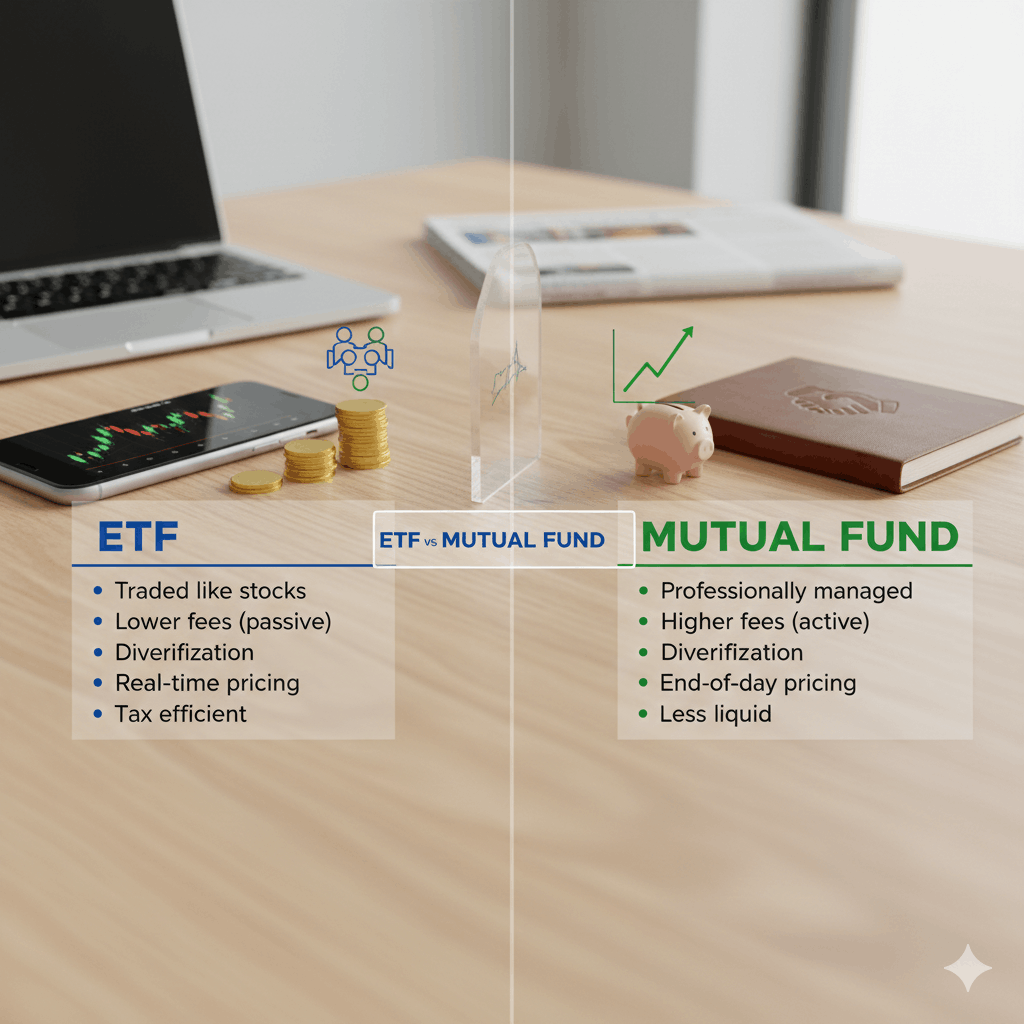
ETF vs Mutual Fund: What’s Better for Long-Term Growth
Choosing between an ETF vs mutual fund feels bigger than it is. Both can be excellent tools for long-term investing. Both can be terrible choices if the fund itself is expensive, poorly matched to your goals, or pushed into constant trading. The wrapper matters, yet what you own and how you behave matter more.
This guide breaks down the ETF vs mutual fund difference in plain language. You’ll get a clear ETF vs mutual fund comparison on costs, taxes, liquidity, NAV pricing, management style, diversification benefits, and suitability for long-term wealth. By the end, you should know whether ETF or mutual fund which is better for your situation.
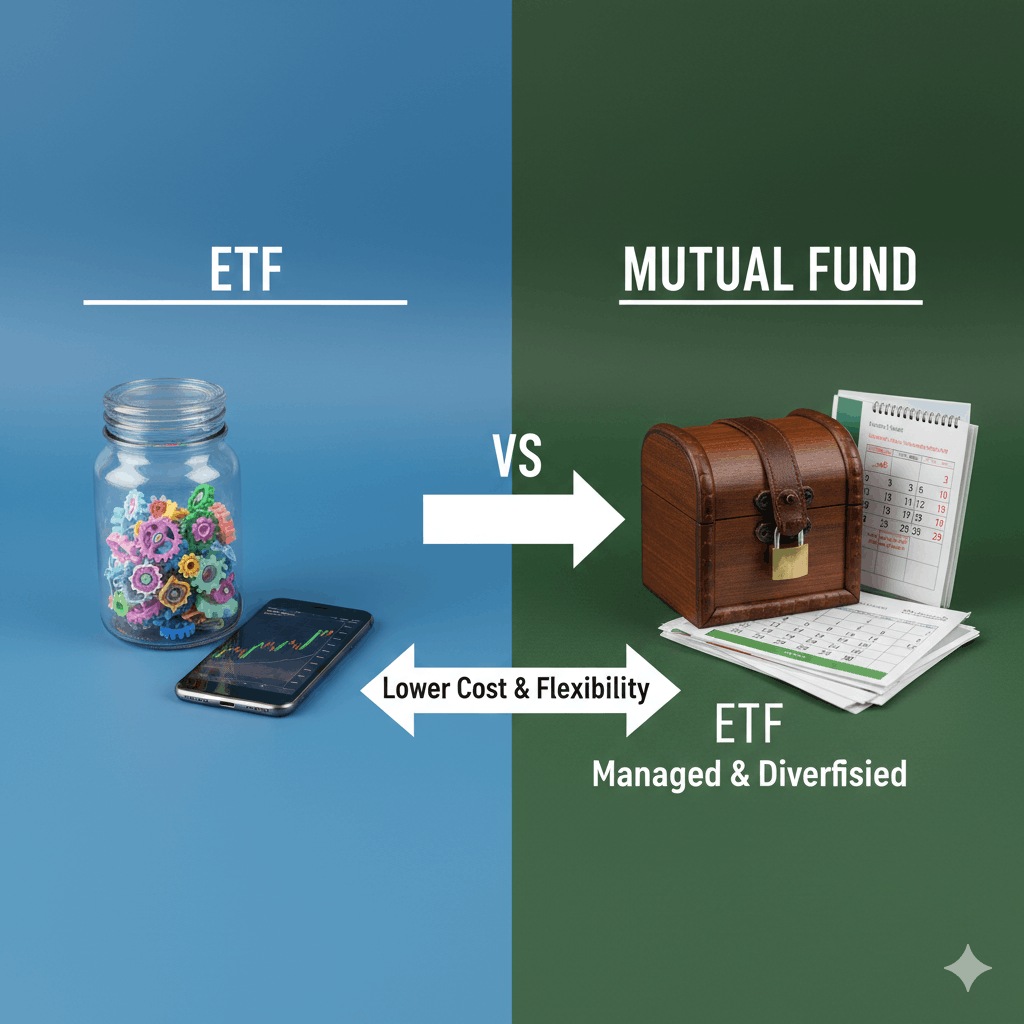
The short answer: ETF or mutual fund which is better for long-term growth
Most long-term investors end up in one of these lanes:
If you invest in a taxable account and care about ETF vs mutual fund tax efficiency, ETFs often have an edge. That edge comes from how many ETFs handle capital gains tax inside the fund, which can reduce surprise taxable distributions.
If you invest through a retirement account, the ETF vs mutual fund for retirement question often becomes a convenience and cost question, not a tax question. Inside many retirement accounts, taxes on distributions are not felt year to year, so expense ratio, automation, and the fund menu matter more.
If you want simple automatic investing, mutual funds can be easier. Many mutual funds support automatic purchases directly from a bank account in clean dollar amounts.
If you want intraday trading and more control over order types, ETFs win on trading flexibility. Long-term investing rarely needs intraday trading, yet some people prefer it.
That is the high-level view. Now let’s unpack what actually drives outcomes.
ETF vs mutual fund difference in one minute
ETFs trade on an exchange during market hours. Their price moves throughout the day, so ETF vs mutual fund intraday trading is a real difference. Mutual funds trade once per day at a price tied to the fund’s net asset value, often called NAV pricing.
This affects how you place orders, how quickly your trade executes, and whether you can use limit orders. It also affects how easy it is to automate investing.
The ETF vs mutual fund NAV pricing point is simple:
ETFs: market price changes all day
Mutual funds: one end-of-day price for everyone
Long-term investing can succeed with either method. Short-term trading can make both harder to use well, just in different ways.
ETF vs mutual fund comparison: what long-term growth truly depends on
A lot of people search “ETF vs mutual fund returns” as if the wrapper controls performance. Usually, returns come from the holdings, not the wrapper.
If an index ETF vs index mutual fund tracks the same index with similar fees and similar tracking, returns often end up close over time. If one costs more, turns over holdings more often, or distributes taxable gains more often in a taxable account, performance can drift.
So when you compare ETF vs mutual fund performance, focus on:
What market exposure does the fund provide
How much does it cost
How taxes hit you in your account type
How the trading mechanics influence your behavior
ETF vs mutual fund fees and costs: more than just the expense ratio
Expense ratio matters. It’s the ongoing annual fee charged by the fund. Many people only look at that number, then stop. That’s not enough for a clean ETF vs mutual fund fees and costs comparison.
You want to understand total friction, which can include:
Expense ratio
Trading costs (spread and slippage for ETFs)
Sales loads or purchase fees on some mutual funds
Account fees at some brokers
Tax drag in taxable accounts
ETF vs mutual fund expense ratio
ETFs are often marketed as cheaper, and many are. Mutual funds have cheap options too, especially index funds.
The important part is not “ETF cheap, mutual fund expensive.” The useful part is: compare the specific funds you might buy. A passive ETF vs mutual fund debate is usually a fee and tax question, not a label question.
Trading friction: where ETFs can cost a bit more than you think
ETFs have a bid price and an ask price. The gap is the spread. The more liquid the ETF, the smaller the spread tends to be. This is a major part of ETF vs mutual fund liquidity discussions.
If you buy a broad, heavily traded ETF and hold it for years, the spread cost can be small. If you trade small niche ETFs often, spreads can eat into results.
Mutual funds do not have spreads in the same way. You buy or sell at the NAV price set at the end of the day. That can feel simpler for long-term wealth building.
ETF vs mutual fund minimum investment
Some mutual funds require a minimum investment. Some do not. Many ETFs have no fund minimum, yet your broker may require buying whole shares unless fractional shares are available.
This is why “ETF vs mutual fund for beginners” often comes down to how someone funds the account. If you invest a set dollar amount each month, a mutual fund can fit neatly. If you want flexibility and your broker supports fractional ETF shares, ETFs can be just as easy.
ETF vs mutual fund tax efficiency: the taxable account dividing line
Taxes are where the ETF vs mutual fund comparison can become meaningful.
ETF vs mutual fund capital gains tax inside a taxable account
Mutual funds can distribute capital gains to shareholders when the fund sells holdings at a gain. Shareholders can owe taxes on those distributions, even if they did not sell their fund shares.
Many ETFs can reduce capital gains distributions through how shares are created and redeemed. This is often called ETF vs mutual fund tax advantages, though it depends on the ETF structure, the holdings, and how the fund is managed.
This is a big reason people ask about ETF vs mutual fund tax efficiency.
When the tax difference becomes smaller
If you hold ETFs or mutual funds inside tax advantaged accounts, the year-to-year capital gains distribution issue often becomes less relevant. Retirement accounts often defer or shelter taxes depending on the account type.
So for ETF vs mutual fund for retirement, taxes often move to the background, and costs, fund quality, and behavior take the lead.
ETF vs mutual fund liquidity and trading flexibility
Liquidity is about how easily you can buy or sell without moving the price much. ETFs trade like stocks, so liquidity is tied to trading volume, spreads, and the liquidity of the underlying holdings.
Mutual funds redeem and issue shares directly with the fund company. You don’t trade with another investor; you trade with the fund itself at NAV pricing.
ETF vs mutual fund trading flexibility
ETFs offer intraday trading and order control. You can place limit orders, avoid buying at a sudden spike, or time a purchase during market hours.
Mutual funds do not give that kind of control. You submit an order and receive the end-of-day price.
For long-term investing, intraday trading can be a temptation. More control can lead to more fiddling, and that can reduce returns if it pushes you into poor timing. For someone who wants set-and-forget, mutual funds can be a better behavioral fit.
ETF vs mutual fund risk, volatility, and diversification benefits
People sometimes assume ETFs are riskier since they trade all day. Risk comes from what the fund owns, not the trading schedule.
ETF vs mutual fund risk is mainly driven by:
Asset class risk (stocks vs bonds vs cash-like holdings)
Sector concentration
Single-country exposure
Credit risk in bond funds
Duration risk in bond funds
Currency risk in international funds
ETF vs mutual fund volatility follows the same pattern. A broad stock index fund will swing more than a short-term bond fund, regardless of wrapper.
ETF vs mutual fund diversification and market exposure
Diversification depends on holdings. Many ETFs and mutual funds offer broad market exposure across hundreds or thousands of companies. That is one reason ETF vs mutual fund stock market investing often points beginners toward index funds.
ETF vs mutual fund diversification benefits can be strong in either wrapper when the fund holds a wide basket.
Passive ETF vs mutual fund: index products often look like twins
If you compare an index ETF vs index mutual fund tracking the same benchmark, the biggest differences often become:
How you buy (intraday vs end-of-day)
How you automate contributions
How taxes hit in taxable accounts
Small differences in expense ratio and tracking
For many long-term investors, both work. This is why the question “ETF or mutual fund which is better” often becomes “which fits my habits and account type.”
ETF vs mutual fund passive investing: what to look for
If your plan is passive investing, look at:
Tracking consistency
Expense ratio
Fund size and stability
Holdings and concentration
Distribution history in taxable accounts
The wrapper is not the strategy. The fund is the strategy.
Actively managed mutual fund vs ETF: where differences show up
Actively managed mutual fund vs ETF comparisons can be more interesting.
Active funds trade more. Higher turnover can lead to more taxable distributions in a taxable account. This connects to ETF vs mutual fund portfolio turnover and ETF vs mutual fund capital gains tax.
Active ETFs exist too, and some still have the tax efficiency benefits of the ETF structure, though results vary by fund.
ETF vs mutual fund management style and transparency
Management style can be active or passive in either wrapper. Transparency differs.
Many ETFs disclose holdings frequently. Many mutual funds disclose less often. Some active ETFs limit transparency using special structures. So ETF vs mutual fund transparency is not one-size-fits-all.
If transparency matters to you, read the fund’s holdings disclosure schedule and understand what you will see and when.
ETF vs mutual fund for beginners: which is simpler
Beginners often want two things: clarity and consistency.
Mutual funds can feel simpler for automatic investing. You can invest exact dollar amounts on a schedule, and you always get the NAV pricing at the end of the day.
ETFs can feel simpler for shopping and comparing. You can see price movements during the day, and it may feel familiar if you’ve seen stock quotes.
ETF vs mutual fund for beginners is often a question of behavior:
If intraday price movement makes you anxious, a mutual fund can reduce the urge to react.
If you like using limit orders and you can avoid overtrading, ETFs can work well.
ETF vs mutual fund long term investing vs short term investing
For long-term investing, the best wrapper is usually the one that keeps you invested and keeps costs low.
ETF vs mutual fund short term investing is a different conversation. Short-term trading tends to increase costs and mistakes for most people, no matter the wrapper. ETFs can make trading too easy. Mutual funds can create frustration because you can’t act quickly, which can push people to chase moves with less discipline.
Long-term wealth building tends to come from patient exposure, not frequent shifting.
ETF vs mutual fund suitability by scenario
This section puts the ETF vs mutual fund comparison into real use cases.
Scenario 1: Taxable account, broad index investing, long holding period
If you’re focused on ETF vs mutual fund tax efficiency, ETFs often have a practical advantage. A broad index ETF held for years can reduce surprise capital gains distributions compared with certain mutual funds.
That does not mean all mutual funds are tax-inefficient. Some index mutual funds are run in a very tax-conscious way. Still, many investors choose ETFs in taxable accounts for this reason.
Scenario 2: Retirement account with payroll contributions
Inside many retirement plans, you pick from a menu of mutual funds, sometimes collective investment trusts, sometimes ETFs in brokerage windows. The “better” option is often the best low-cost diversified fund available in that plan.
ETF vs mutual fund for retirement becomes about:
Fee level
Diversification
Consistency
Ease of contribution and rebalancing
Scenario 3: Small monthly contributions, fixed dollar amounts
If your broker supports automatic ETF purchases and fractional shares, ETFs can fit nicely. If not, mutual funds can be smoother since you can buy in exact dollars without thinking about share price.
This is where ETF vs mutual fund minimum investment and brokerage features matter more than theory.
Scenario 4: Investor who tends to trade too much
If someone struggles with impulsive trading, the mutual fund structure can act like a guardrail. You can still sell a mutual fund, yet you cannot stare at minute-by-minute price swings and hit buttons all day.
If you want long-term wealth, behavior matters.
Scenario 5: Active strategies or niche exposure
If you’re buying a specialized active fund, compare total costs, turnover, taxes in taxable accounts, and transparency. An actively managed mutual fund vs ETF choice is not automatic. Some active mutual funds have long track records and stable processes. Some active ETFs may offer better tax results. The fund details decide the outcome.
ETF vs mutual fund pros and cons without hype
A clean ETF vs mutual fund pros and cons view can keep you grounded.
ETFs tend to offer intraday trading, easy price visibility, and often strong tax efficiency in taxable accounts. They may come with spreads and can tempt overtrading.
Mutual funds tend to offer simple automatic investing, clean end-of-day NAV pricing, and can reduce trading impulses. Some have minimums, some have sales loads, and taxes in taxable accounts can be less friendly in certain cases.
No wrapper guarantees better long-term growth. A cheap diversified fund held consistently tends to beat a fancy approach held inconsistently.
A practical checklist to decide in 60 seconds
Use this checklist to land the ETF vs mutual fund investment strategy choice quickly:
Start with your account type. Taxable accounts put more weight on tax efficiency. Retirement accounts put more weight on costs and convenience.
Next, look at the fund exposure. Compare market exposure, not brand names.
Then compare total cost. Include expense ratio and realistic trading friction.
Then look at how you will invest. Automatic monthly dollars often point to mutual funds unless your broker supports easy ETF automation.
Then check your behavior. If intraday charts trigger stress or impulsive trades, mutual funds can be a better fit.
Conclusion
ETF vs mutual fund is not a battle where one always wins. In long-term growth, holdings, costs, taxes, and behavior drive results. ETFs often shine in taxable accounts due to tax efficiency and trading flexibility. Mutual funds often shine in automation and habit-building, which can be just as valuable for long-term wealth. Pick the wrapper that helps you stay consistent, keep costs low, and avoid reacting to market noise.


