

What Is a Good Credit Score and Why It Changes
A credit score can feel like a single, fixed judgment about you. In real life, it is closer to a moving snapshot. It reacts to what shows up on your credit reports, when lenders update those reports, and how a scoring model reads the data at that moment.
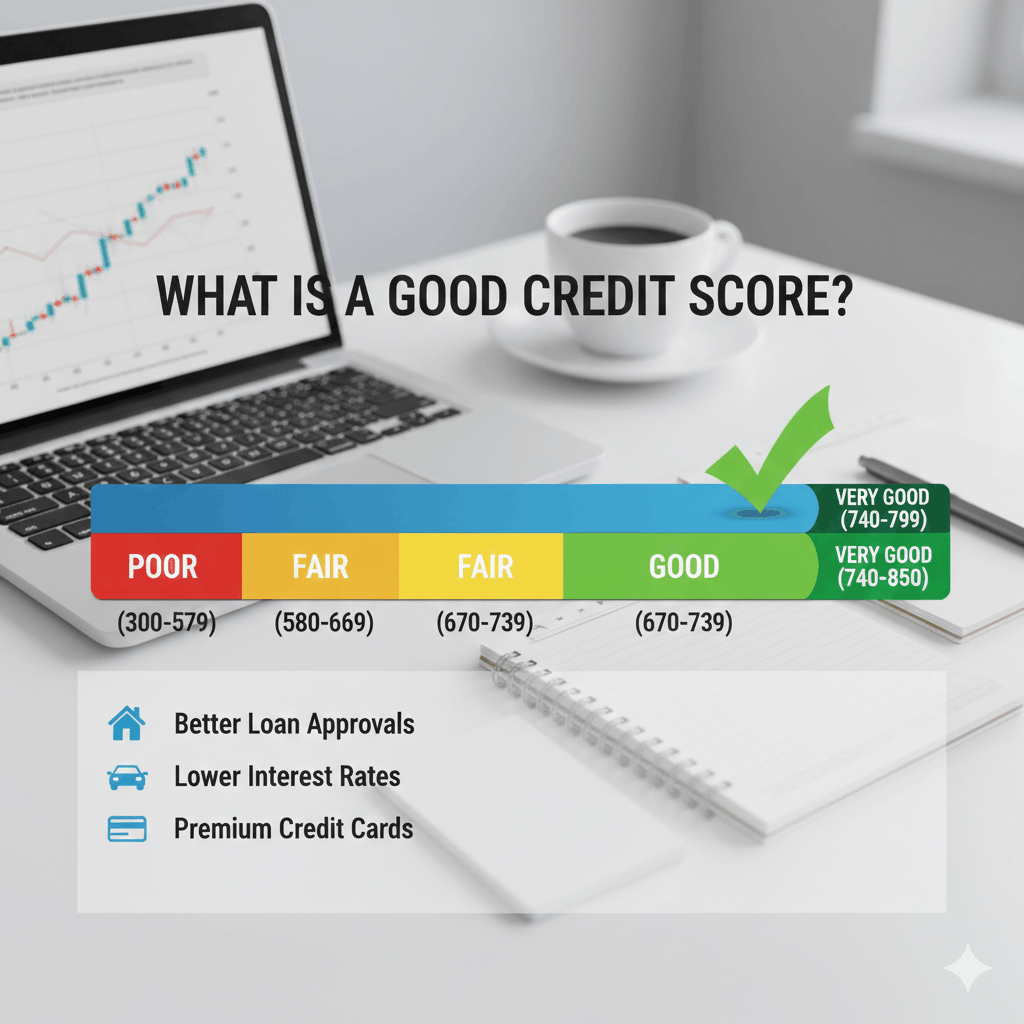
If you are searching what is a good credit score, you usually want two things: a clear range that lenders tend to like, and a plain-language explanation for why your number sometimes shifts even when your habits stay steady. This guide covers credit score meaning, the good credit score range across common models, credit score tiers, and the everyday reasons a personal credit score moves.
Credit score meaning: the simple idea behind the number
Credit score meaning is straightforward: it is a three-digit summary that estimates how likely a borrower is to repay borrowed money on time. Lenders use it as one input when deciding loan approval, credit score requirements, and pricing like interest rates.
Credit score definition in plain language
A credit score definition can be stated without jargon:
A credit score is a number created from the information in your credit report that helps predict future repayment behavior.
That is why you might see terms like creditworthiness score or consumer credit rating used in conversations about lending. They all point to the same concept: a quick way for a lender to compare risk across applicants.
Credit score explained without the fluff
Credit score explained in practical terms looks like this:
- Your credit report contains your account history, balances, limits, payment record, and a few other data points.
- A scoring model reads that report and assigns a number inside a defined range.
- That number is placed into credit score brackets that lenders interpret as poor, fair, good, or excellent.
That last part matters a lot. Lenders rarely react to a one-point change. They react to credit score classification and where your number sits inside those brackets.
The score range and the score model: why two people can both be “right”
People talk about good credit score range as if there is one universal chart. In practice, ranges depend on the model used. Two names show up most often: the FICO credit score scale and the VantageScore range.
Both are widely recognized credit score basics in the US market, and both commonly use a 300–850 scale. The group labels differ.
FICO credit score scale and score brackets
On the base FICO credit score scale, the commonly cited credit score tiers look like this:
Poor credit score range
Poor credit score range sits below the fair band. This bracket tends to bring higher interest rates, tighter credit score requirements, and more rejections.
Fair credit score range
Fair credit score range is a middle area where approvals are possible, though pricing can be expensive and minimum credit score for loans can vary widely.
Good credit score range
The good credit score range is widely described as the point where approval odds improve and pricing begins to look more competitive. On many FICO charts, good starts at 670 and runs through 739.
Very good and exceptional tiers
Above good comes very good, then the top tier where you may see the best credit score range benefits. On many FICO charts, exceptional begins around 800.
This structure is helpful when someone asks what is considered a good credit score. It gives a clean answer, then adds context: good is a band, not a single “pass/fail” line.
VantageScore range and credit score classification
VantageScore uses different names for credit score classification. A common breakdown is:
- Subprime
- Near prime
- Prime
- Superprime
In this system, prime is often treated like “good,” and superprime maps to “excellent.”
The key practical takeaway is not which brand label you prefer. The practical takeaway is that your credit score brackets can shift slightly depending on model, and lenders decide which model they pull.
What is a good credit score: the range most lenders like
So, what is a good credit score?
A common answer on the base FICO scale is 670 to 739. On VantageScore 3.0, a common “good” band is 661 to 780. These are both treated as good credit score range references in consumer education, and both are used to explain what is considered a good credit score in everyday lending conversations.
A healthy credit score is not only about hitting a label like “good.” It is about staying inside a range that helps you qualify for credit with reasonable terms.
Good credit score number vs “good enough”
People often ask for a good credit score number as if one number guarantees approval. Approval depends on the lender, the product, your income, your debt, and the details in your credit history score.
A better way to think about it:
- A good score often improves loan approval odds.
- A good score often helps with interest rates.
- A good score does not automatically override weak application details.
This viewpoint reduces stress when your score swings a little. A strong application profile is more than a single number.
Credit score above 700: what it usually signals
A credit score above 700 is commonly seen as a solid sign of responsible credit use. Many borrowers in this band can qualify for a broad set of products. Lenders still look at the full credit profile score, yet a 700+ score often places you in a more comfortable credit score classification.
Credit score above 750: when pricing often improves
A credit score above 750 is frequently associated with stronger terms on many products. You may see better pricing and more flexible approvals, especially when the report shows long payment history and sensible credit utilization ratio.
Credit score above 800: top-tier territory
A credit score above 800 is often placed in the highest credit score brackets on the FICO scale. This tier is sometimes described as exceptional. People in this band typically have a long track record of on-time payments, modest utilization, and a mature account history.
Highest credit score possible and the idea of a perfect credit score
The highest credit score possible on the common 300–850 scale is 850. People sometimes call this a perfect credit score.
In practice, chasing 850 is rarely necessary. Many lenders price their best offers inside a band, not at a single “perfect” point. Past a certain level, the differences in pricing can be small, and other parts of the application can matter more.
This is where the phrase ideal credit score needs nuance. “Ideal” often means “strong enough to qualify for top-tier terms,” not “the absolute maximum number.”
Average credit score: what it tells you (and what it does not)
Average credit score figures help you compare your personal credit score with a national snapshot. They can reduce anxiety when you feel behind, or keep you grounded when your number looks high.
Recent reporting has placed the average FICO score in the US around the low 700s, with one widely cited figure at 715. A separate reported share of consumers have a good or better score at 670 or higher.
Averages are not targets. They are context.
- A person with a score below average can still qualify for credit.
- A person with a score above average can still face denials if their report has recent late payments, high utilization, or thin history.
Your credit profile score matters more than comparing yourself to the average credit score headline.
Why credit score matters in real life
When people ask why credit score matters, they are really asking what changes after the number improves.
The importance of good credit score shows up in approvals, pricing, and friction during application reviews. The benefits of good credit score can appear in more places than loans.
Credit score and interest rates
Credit score and interest rates are strongly linked in many lending products. Higher scores often align with lower rates because the lender expects less default risk. Even a small rate change can add up across years, especially for large balances.
Credit score and loan approval
Credit score and loan approval go together, though approval is never purely score-based. Lenders may check:
- Score
- Payment patterns
- Debt levels
- Income and employment
- Recent application activity
A good score can move you into a friendlier category, yet you still need a stable application profile.
Credit score and mortgage approval
Credit score and mortgage approval is a topic where score thresholds get attention. Mortgage lenders typically set credit score requirements that can be stricter than some other products. A stronger score can widen options for loan types and pricing.
Still, mortgage approval often includes a deep review of income, debt-to-income ratios, and reserves. That is why a good score helps, yet it is only one part of the file.
Credit score for credit cards
Credit score for credit cards varies by card type. Entry-level cards can approve borrowers with fair scores, secured cards may approve with limited history, and premium cards often expect a higher bracket.
Credit score classification matters a lot here. Card issuers often target certain tiers with marketing and pre-approvals.
Credit score for car loans
Credit score for car loans influences the APR and the down payment expectations. Auto lending can be more flexible in approval, yet pricing differences between tiers can be large.
A strong score can reduce the total cost of the loan, not only the monthly payment.
Credit score for personal loans
Credit score for personal loans is heavily tied to pricing and approval limits. Many personal loan lenders price based on risk tiers. A good score can open longer terms and lower APRs, though income and existing obligations still matter.
Minimum credit score for loans and “requirements”
People search minimum credit score for loans because they want a simple threshold. In reality, minimums vary by lender, product, and your broader file.
A lender may publish broad credit score requirements, yet internal underwriting can still override them. The practical approach is to treat minimums as rough guidance, then focus on improving the factors lenders repeatedly reward.
How credit scores work: why your number changes
Credit scores work by taking information from your credit report and turning it into a score through a model. When the report changes, the score can change.
A score can move even when your day-to-day spending feels stable. Small shifts in balances, reporting dates, and account status updates can be enough.
The reporting cycle: timing is a quiet driver
Most lenders report activity to credit bureaus on a schedule. Credit card balances often get reported around statement closing dates, not the day you pay. That creates a situation where you pay in full, yet your reported balance still looks high for a short time.
This is one reason people feel confused. Their bank account shows payment, yet the credit history score reflects a prior snapshot.
Credit utilization ratio: the most common reason for short-term swings
Credit utilization ratio is the share of your available revolving credit that is currently used. It changes as you spend and as balances report.
Even a person with a healthy credit score can see a dip after a month with higher card balances, even if they pay on time. The score is reacting to what got reported.
Utilization can change in two ways:
- Balances go up or down
- Limits go up or down
A lower limit or a closed card can raise utilization even with the same spending.
Payment history impact: long memory, big influence
Payment history impact tends to be strong across scoring systems. A late payment can hurt quickly and can linger. The effect varies with severity, recency, and frequency.
This is why people see bigger drops after missed payments than after routine balance changes.
Length of credit history: aging changes the math
Length of credit history grows with time. As accounts age, the file can look more stable to scoring models.
Score changes related to age tend to be gradual, not sudden. Sudden changes can still happen if a long-held account closes and the model responds to the altered profile.
Credit mix impact: variety can help, yet it is not mandatory
Credit mix impact refers to the blend of account types, often separated into revolving accounts (credit cards) and installment accounts (auto loans, mortgages, student loans, personal loans).
A well-managed mix can support a stronger score. Still, you do not need to borrow money just to create mix. A score can be strong with simple accounts handled well.
New credit inquiries: hard inquiry vs soft inquiry
New credit inquiries matter because they can signal risk. Models may treat many recent applications as a sign of financial stress.
Hard inquiry vs soft inquiry matters here:
- A hard inquiry is tied to a credit application and can affect the score for a period of time.
- A soft inquiry is a check that is not tied to a credit application, like many personal checks, pre-qualification checks, or account reviews.
This is one reason the myth “checking your score lowers it” keeps spreading. In many cases, a personal credit score check is a soft inquiry.
Errors and mismatches: the silent score movers
Credit reports are not perfect. A wrong balance, a payment marked late by mistake, or a mixed file can pull a score down. Errors can create score movement that feels random.
This is why credit score monitoring and periodic credit score report review can be helpful. You are not only watching the number. You are watching the data behind it.
Factors affecting credit score: what models tend to measure
Factors affecting credit score can be grouped into a few themes. The labels vary by model, yet the ideas overlap.
Payment behavior factors
Payment behavior factors revolve around whether payments were made on time, how late they were, and how recently it happened. Repeated late payments generally have more weight than a single slip.
Balances and utilization
This category includes revolving balances, the credit utilization ratio, and patterns like carrying high balances month after month.
Account age and stability
This includes the age of your oldest account, the average age of accounts, and how frequently new accounts appear.
Recent activity
Recent activity includes new accounts, hard inquiries, and sudden shifts in balances.
This section ties directly to why a score changes. Most changes come from new information entering one of these buckets, even when it feels minor.
What is considered a good credit score for your age or stage of life
People at different stages of life face different credit score basics.
Someone who is 19 and just opened their first account is dealing with limited data. Someone who is 45 with a long history has more evidence in their file.
A newer borrower can still reach a good score, yet the path often involves time and consistency more than complex tactics.
Good credit score for beginners: first-time borrowers and thin files
Good credit score for beginners is a popular search because beginners want to know what “normal” looks like early on.
Starting credit score and entry-level credit score concepts
A starting credit score is not always immediate. Many scoring models need enough reported history to generate a score. That means a person can have a credit account yet still not have a score for a period of time.
An entry-level credit score, once created, can vary widely based on early behavior: payment timing, utilization, and whether accounts remain in good standing.
Credit score without credit history: what to do first
Credit score without credit history is a real situation. The fastest healthy approach is usually to start with a product designed for new borrowers, then build a steady record.
Common starting points include a secured credit card or a starter card from a bank or credit union. The goal is not to run up spending. The goal is to build a clean payment record and keep utilization modest.
How to check credit score and know what you are looking at
How to check credit score is easy today. The harder part is understanding which score you are viewing and what data it used.
How to know your credit score across platforms
Different apps can show different numbers. That does not always mean one is wrong. It often means they are using different scoring models or pulling data from different bureaus.
That is why you may see one score on a bank dashboard and a different one on a monitoring app.
Credit score check free options and limits
Credit score check free tools can be useful, especially for trend tracking. For lending decisions, a lender might pull a different score version than the one shown to you.
Use free tools to watch direction. Use your credit score report to verify the underlying details.
Credit score report basics: what matters beyond the number
A credit score report review should focus on:
- Accounts you recognize
- Payment status accuracy
- Balances and limits
- Derogatory marks, collections, public records where applicable
- Inquiries you recognize
This review improves your credit profile score by improving your understanding of what is being measured.
How to get a good credit score: the habits that usually work
How to get a good credit score is not about shortcuts. It is about a small set of behaviors repeated long enough to become your normal.
How to build credit score: a calm framework
How to build credit score typically comes down to:
- Pay on time, every time
- Keep revolving balances reasonable relative to limits
- Avoid frequent new applications
- Keep accounts open in good standing when possible
That is the spine of credit score building steps for most people.
Tips for good credit score that stay practical
Tips for good credit score are most useful when they are easy to live with.
Pick one payment method that reduces missed dates. Autopay for minimums can help protect payment history, then you can pay the full balance manually if that fits your style.
Keep an eye on utilization. If a month will be heavy, paying early or splitting payments can reduce the reported balance.
Apply for new credit with a purpose. A spree of applications can add hard inquiries and reduce average account age.
Credit score improvement strategies that match real life
Credit score improvement strategies are usually about reducing risk signals.
If utilization is high, focus on paying down revolving balances first. If payment history is damaged, focus on staying current going forward and keeping all accounts clean. Time helps more than tricks in this category.
If errors exist, fix the data. An inaccurate late payment can hold a score down unfairly.
How to improve credit score after a drop
How to improve credit score after a drop begins with identifying the cause.
- If the drop came from utilization, the fix may be fast after balances report lower.
- If the drop came from a late payment, improvement usually takes longer.
- If the drop came from a new account, the score may stabilize as the account ages and the file regains balance.
Credit repair basics: rebuilding credit score without panic
Credit repair basics means focusing on accuracy and consistency.
- Confirm report accuracy
- Bring all accounts current
- Keep revolving balances manageable
- Avoid adding new risk signals during the rebuild
Rebuilding credit score is often slower than building it the first time. The emotional side matters too. A disciplined routine beats constant checking.
Maintaining good credit score: the long game
Maintaining good credit score is mostly about staying boring:
- Pay on time
- Keep utilization from creeping upward
- Avoid unnecessary new debt
- Review reports at intervals
This is where credit score monitoring helps. You are watching for drift, not chasing daily movement.
Bad credit vs good credit: what changes between the two
Bad credit vs good credit is not only a label. It changes the doors that open.
In poor or fair ranges, many borrowers face higher interest rates, stricter loan approval, and more requests for deposits or collateral.
In good and excellent ranges, borrowers often see:
- More approvals
- Larger limits
- Better pricing
- Faster underwriting
That is the practical impact of credit score classification.
Credit score myths and common credit score mistakes
Credit score myths thrive because scores feel mysterious. Clearing the myths makes score changes easier to handle.
Myth: checking my score lowers it
Many personal score checks are soft inquiries. Soft checks do not carry the same impact as a hard inquiry tied to a new application.
Confusion often happens when someone checks their score right after applying for a loan. The application triggered a hard inquiry, not the score check itself.
Myth: carrying a small balance is required
Some people believe they need to carry a balance and pay interest to build credit. Paying interest is not required. A record of on-time payments and sensible utilization can build a strong profile without interest charges, depending on how balances report.
Myth: closing a card “cleans up” the profile
Closing a card can reduce total available credit and raise utilization. It can also reduce account depth over time. Closing can be right in certain cases, yet it is not a universal fix.
Common credit score mistakes that cause avoidable drops
Common credit score mistakes include:
- Missing a payment by a few days
- Letting utilization spike for several months
- Applying for many accounts close together
- Ignoring report errors
None of these are permanent disasters. Each has a clear path back, though timelines differ.
Wrap-up
If you came here asking what is a good credit score, the simplest answer is that “good” is a range, and the range depends on the score model. Once you understand the credit score brackets on the FICO credit score scale and the VantageScore range, score changes become less confusing. Most movement comes from reporting timing, credit utilization ratio shifts, new inquiries, and the normal aging of accounts. Build steady habits, review the report data behind the number, and treat the score as a snapshot that updates with new information.


