

Credit Utilization Ratio: The Fastest Fix to Boost Your Score
Credit Utilization Ratio is one of the few credit score inputs that can move quickly. A late payment can drag a score down for a long time. A new account can take time to settle. Credit Utilization Ratio is different. It can rise and fall within a single billing cycle, then show up on your credit reports soon after.
That speed is why this topic keeps coming up right before a loan application. A person sees a score drop, checks their credit card utilization rate, and realizes the used credit vs available credit picture changed more than they expected. The good news is that many Credit Utilization Ratio problems come from timing and balance placement, not from long-term damage.
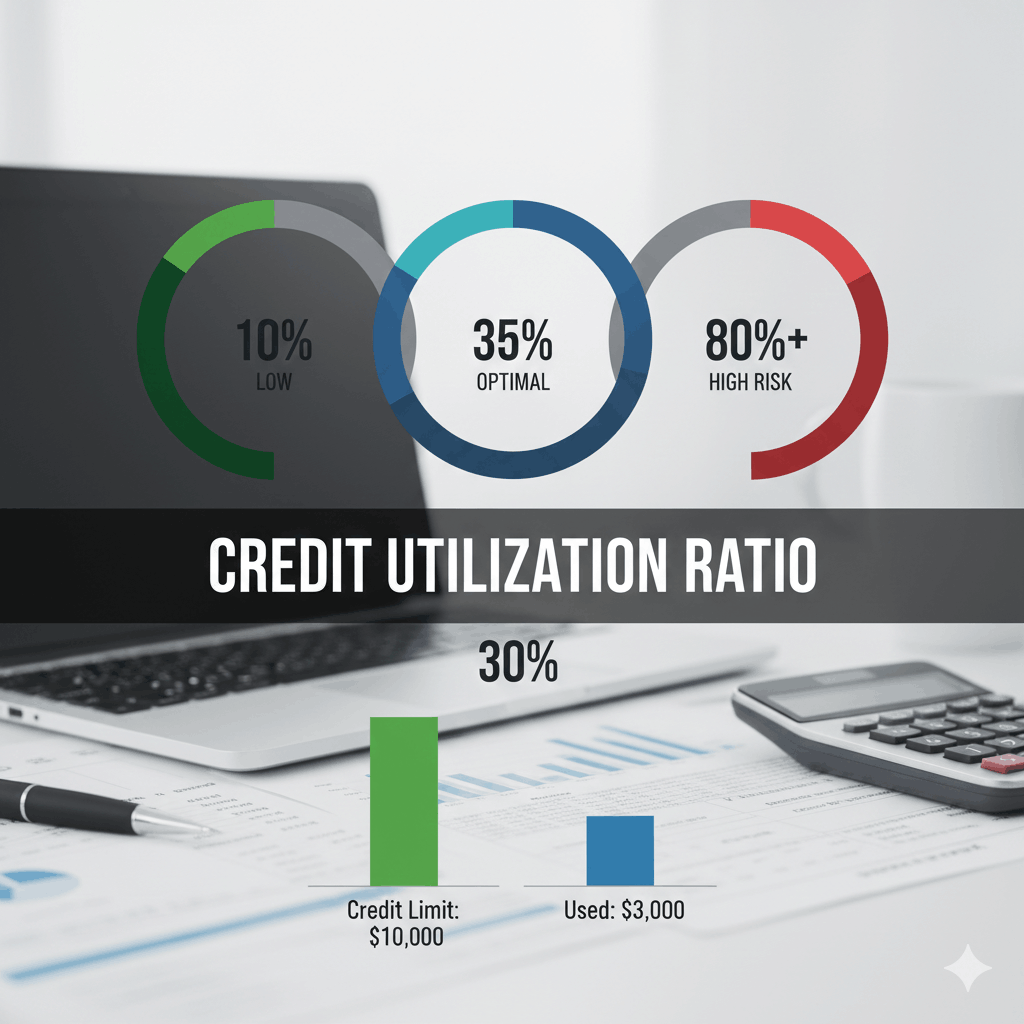
This guide breaks down credit utilization explained in clear language, credit utilization calculation, overall credit utilization versus per-card credit utilization, credit utilization thresholds like credit utilization under 30 percent and credit utilization under 10 percent, plus practical ways to reduce credit utilization and lower credit utilization fast. It finishes with credit utilization myths, credit utilization mistakes, and a clean routine for credit utilization monitoring.
Credit utilization explained: what the ratio really measures
Credit utilization is your credit usage percentage on revolving accounts. Revolving credit utilization usually refers to credit cards and lines of credit that have a limit. Installment loans like auto loans work differently, so they are not the main driver in this ratio.
Credit Utilization Ratio answers a simple question: how much of your revolving credit limit usage is currently used?
You may see this concept described in different phrases:
- credit limit usage
- available credit ratio
- credit balance to limit ratio
- used credit vs available credit
- credit card utilization rate
These phrases point to the same measurement. A credit card with a $1,000 limit and a $500 balance has a credit usage percentage of 50% on that card.
Revolving credit utilization and why cards get so much attention
Revolving credit utilization matters a lot since credit cards update frequently and balances can swing. A person can go from low credit utilization to high credit utilization in one month with a single large purchase, even with on-time payments.
That is why Credit Utilization Ratio often feels like the “fast” part of credit scoring. It reacts to monthly reporting.
Credit utilization vs credit limit: what people mix up
Credit utilization vs credit limit confusion is common.
- Credit limit is the maximum a lender allows on a card.
- Credit utilization is the portion of that limit that is used at the time the balance is reported.
A higher limit can help your ratio, though only if spending does not rise in step with the limit.
How credit utilization affects credit score
Credit utilization impact on credit score is tied to risk signals. High revolving credit utilization can look like strain, even when payments are on time. Low credit utilization looks calmer.
Many scoring breakdowns describe “amounts owed” as a large slice of scoring, often listed around 30% on widely used FICO models. Credit Utilization Ratio is one of the biggest parts inside that slice. A sharp rise in credit card utilization rate can lead to a quick score dip. A sharp drop can lead to a quick rebound.
That is why people call this the fastest fix. It is not magic. It is a quick-moving input.
Credit utilization and borrowing power
Credit utilization and borrowing power are tied together in lender decisions. A lender wants to know how much revolving credit you already rely on. If you are close to limits, the lender may view a new loan as higher risk.
Even when a lender approves a loan, high credit utilization can influence the offered interest rate or the approved amount.
Credit utilization and loan approval
Credit utilization and loan approval connects in two ways:
- The score impact: utilization can move the score used in automated screening.
- The underwriting view: lenders can see high used credit vs available credit and worry about payment stress.
A person can have a decent score and still run into trouble if several cards sit near the limit.
Credit utilization and interest rates
Credit utilization and interest rates is not only about the score number. Underwriters can price based on risk bands. High credit utilization can push the file into a pricier band, even when the score stays above a lender’s minimum.
Credit utilization and FICO score vs credit utilization and VantageScore
Credit utilization and FICO score topics often include one recurring surprise: your score can look different across apps. Credit utilization and VantageScore questions pop up for the same reason. Different models, different versions, sometimes different bureau data.
The utilization concept is shared: revolving balances compared with limits. The sensitivity can vary. One model may react more strongly to a high balance on a single card. Another may lean more on total utilization.
Do not panic over small differences between models. Focus on the report data: balances, limits, and reporting dates.
Credit utilization calculation: how to calculate credit utilization ratio
Credit utilization calculation is straightforward.
Credit Utilization Ratio = total revolving balances ÷ total revolving credit limits
Then multiply by 100 for a credit usage percentage.
A simple overall credit utilization example
If you have two cards:
- Card A: limit $2,000, balance $200
- Card B: limit $3,000, balance $900
Total balance is $1,100. Total limit is $5,000.
Overall credit utilization is $1,100 ÷ $5,000 = 0.22, or 22%.
This is overall credit utilization, sometimes called aggregate credit utilization or aggregate credit utilization rate.
Individual card utilization matters too
A common mistake is focusing only on overall credit utilization. Individual card utilization can carry weight. Per-card credit utilization can hurt when one card is near max, even if the total looks safe.
Using the same example, Card B alone is $900 ÷ $3,000 = 30%. Card A is 10%.
That pattern is fine for many people. A different pattern can look riskier:
- Card A: $1,800 of $2,000 (90%)
- Card B: $0 of $3,000 (0%)
Total is still 36% overall, yet one card is extremely high. Scoring can react to that high individual card utilization.
Credit utilization vs debt ratio
Credit utilization vs debt ratio confusion shows up often. Credit utilization is about revolving limits. Debt ratio often refers to debt-to-income, which compares monthly debt obligations to income. They are separate measurements. Credit Utilization Ratio can shift without income changes. Debt-to-income changes when payment obligations change.
Credit utilization thresholds: what counts as “good”
People want one number for optimal credit utilization. Real lending is more flexible than one hard line, yet credit utilization thresholds do exist as practical targets.
Credit utilization under 30 percent: the common baseline
Credit utilization under 30 percent is often used as a broad benchmark for a healthy profile. It is not a guarantee. It is a useful line for many borrowers.
If you are currently above 30%, lowering it can produce noticeable score movement, especially if you drop from very high credit utilization down into a calmer range.
Credit utilization under 10 percent: the stronger target
Credit utilization under 10 percent is frequently associated with higher score ranges. Many people who sit in top tiers keep the credit card utilization rate in single digits across months.
This is where the phrase ideal credit utilization percentage often lands. A single-digit credit usage percentage can look strong, as long as the file is otherwise clean.
Low credit utilization vs “too low”
Low credit utilization is usually positive, yet there is a nuance that surprises people. Some scoring setups may prefer seeing a small reported balance on at least one card, rather than all cards reporting zero every month.
This does not mean you must carry debt and pay interest. It points to reporting patterns. If every card reports zero all the time, the model sees little recent revolving activity.
A practical approach is simple: keep utilization low and let at least one card report a small balance now and then, then pay it off by the due date if that matches your budget.
Credit utilization reporting: why timing changes everything
Credit utilization reporting is the reason many people feel confused.
A credit card statement closing date is often when the balance gets reported to bureaus. The due date is when the payment is required to avoid late status. Those are different dates.
If you pay after the statement closes, the card may still report the higher balance for that month. Your score can look worse until the next update.
This is why someone can pay a card in full and still see high credit utilization in credit reports for a short period.
Credit utilization in credit reports: what you will see
On a typical credit report, you may see:
- current balance
- credit limit
- date reported
- payment status
That data creates your available credit ratio. When those values update, Credit Utilization Ratio can update fast.
Credit utilization trends and why month-to-month swings happen
Credit utilization trends often follow real life: holidays, travel, car repairs, school expenses. A person can maintain good habits and still see a temporary utilization spike.
A short spike is not the same thing as chronic high credit utilization. Scoring tends to respond to what is recent, yet longer patterns matter in overall credit health.
Lower credit utilization fast: the fastest moves that work in real life
Lower credit utilization fast methods come down to two levers: reduce balances, raise limits. Reducing balances is usually the cleanest. Raising limits can help too, though it depends on lender policies and your spending habits.
Pay before the statement closes
This is one of the most effective credit utilization strategies.
If your statement closes on the 20th and you usually pay on the 25th, your report may show a high balance each month. Paying part of the balance before the 20th can lower the reported balance.
This change can reduce credit utilization quickly without changing total spending. It mainly changes what gets reported.
Split payments within the month
A split-payment approach supports credit utilization management. Instead of one payment, make two smaller payments. One can fall mid-cycle. One can fall near the due date.
This can keep the credit card utilization rate lower at reporting time.
Focus on the card with the highest per-card utilization
Per-card credit utilization often drives score drops. If one card is near its limit, paying that card down first can produce better score movement than spreading payments evenly across several cards.
A simple approach is to lower any card above 70% first, then lower cards above 50%, then lower cards above 30%. This reduces high-risk signals early.
Keep spending on a high-limit card instead of maxing a small-limit card
Some people have multiple cards with very different limits. Putting most charges on a $500-limit card can create high revolving credit utilization quickly. Shifting routine spending to a higher-limit card can lower credit usage percentage on the small-limit card.
This is credit utilization optimization in a practical sense. It is about balance placement, not about spending more.
Ask for a credit limit increase the right way
A limit increase can lower the Credit Utilization Ratio immediately if spending stays stable.
A few notes matter:
- Some issuers do a hard inquiry. Some do not.
- A hard inquiry can cause a small score dip in the short term.
- A limit increase helps only if it does not trigger higher spending.
If you are close to a major application, it can be smart to avoid new inquiries. The timing matters.
Avoid closing cards if the goal is utilization improvement
Closing a card can shrink your total available credit ratio. That can raise overall credit utilization without any new spending.
There are cases where closing a card is still the right call, like high annual fees you cannot justify. If utilization is the main goal, keep the math in mind.
Ways to improve credit utilization for long-term credit health
Fast fixes help. Long-term stability comes from routines that support credit utilization and credit health.
Build a spending ceiling that keeps utilization low
A simple method is to treat a card like it has a “personal limit” lower than the bank limit. If your goal is credit utilization under 10 percent, set your monthly charge target around 10% of the limit, then adjust if your budget needs more flexibility.
Use autopay for minimums, then pay the rest manually
Late payments are far more damaging than utilization changes. Autopay for minimums protects payment status. Then you can pay down balances before the statement close if you are working on Credit Utilization Ratio.
Keep an emergency plan that avoids maxing cards
Credit utilization and debt management connect strongly during emergencies. A car repair can push utilization high. A small cash buffer or a plan for quick payoff can prevent that balance from lingering for months.
Credit utilization mistakes that keep scores stuck
Credit utilization mistakes are usually simple behavior patterns that feel harmless.
Mistake: ignoring per-card utilization
A person checks overall credit utilization and sees 25%, then assumes all is fine. One card is sitting at 95%. That one card can still pull the score down.
Mistake: letting a high balance report for rewards points
Some people run large charges to chase rewards, then pay later. If the high balance reports, the score may drop. Paying before the close date keeps rewards, yet avoids high reporting balances.
Mistake: applying for new credit to fix utilization
A new card can raise available credit. It can raise total limits. It can help the ratio. It can create a hard inquiry and reduce average account age. That mix can backfire in the short term.
If you need a score bump soon, balance reduction and reporting timing usually beat opening new accounts.
Credit utilization for beginners: why swings feel larger
Credit utilization for beginners can feel harsh. A thin file has fewer accounts and less history. A single high balance can have a stronger impact on the overall credit profile.
A beginner-friendly routine looks like this:
- Keep one card active with small monthly charges.
- Pay before the statement closes if the balance climbs.
- Avoid running close to the limit on any one card.
This supports credit utilization and responsible borrowing habits without complex tactics.
Credit utilization for credit repair: where to start when rebuilding
Credit utilization for credit repair is often about stabilizing the revolving picture after a rough patch.
Start with these priorities:
- Keep every account current.
- Bring any maxed cards down first.
- Aim for credit utilization under 30 percent as an early milestone.
- Work toward credit utilization under 10 percent after stability returns.
If there are missed payments or collections, utilization fixes will not erase that history. They can still lift the score and improve loan approval odds as the file heals.
Credit utilization and financial planning: making the ratio fit your life
Credit utilization and financial planning should feel realistic. A ratio is not a moral grade. It is a measurement.
If your budget requires you to use credit cards for cash flow, focus on two ideas:
- Lower balances before reporting dates.
- Reduce the time high balances stay on the account.
This approach supports credit utilization management without forcing a lifestyle change overnight.
Credit utilization myths that waste time
Credit utilization myths spread fast since people want simple rules.
Myth: carrying a balance helps the score
You do not need to pay interest to build a score. A card can report a balance, then you can pay by the due date. The reported balance and the paid balance are separate timing points.
Myth: only overall utilization matters
Overall credit utilization matters. Individual card utilization can matter too. Treat both with respect.
Myth: utilization is the same as debt-to-income
Credit utilization vs debt ratio confusion shows up here. Utilization is about revolving limits. Debt-to-income is about monthly debt payments compared with income. They are separate.
Final thoughts
Credit Utilization Ratio is one of the quickest-moving pieces of a credit score. It responds to the credit card utilization rate that gets reported, not the spending story in your head. Once you understand credit utilization calculation and credit utilization reporting timing, you can reduce credit utilization in a controlled way. Start by lowering high per-card credit utilization, then bring overall credit utilization into a calmer range. Track credit utilization in credit reports monthly, not daily, and keep the routine simple.


