

How to Dispute Credit Report Errors Step by Step
Dispute Credit Report Errors is one of the most practical skills in personal finance. A credit report error dispute can protect your loan approvals, keep interest rates from creeping up, and stop a small reporting mistake from turning into a months-long headache.
Credit report inaccuracies happen for normal reasons: data entry issues, timing problems, duplicate reporting, accounts that belong to someone with a similar name, or fraud. When those credit reporting errors land on your file, they can change how lenders read your risk. A clean credit report correction process gives you a way to fix credit report errors with a paper trail and a predictable timeline.
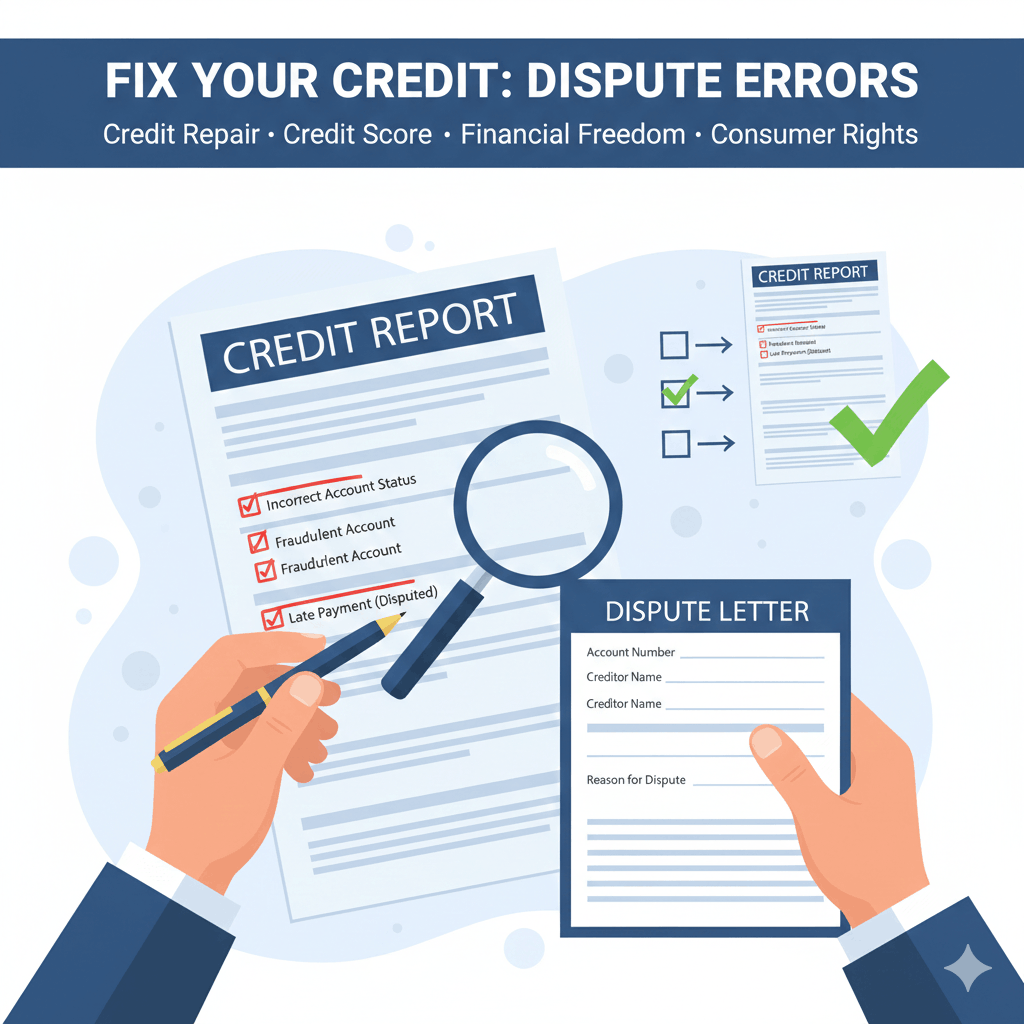
This guide walks through how to dispute credit report errors from start to finish: how to verify credit report information, how to build credit dispute documentation, how to file a credit report dispute online or by mail, what the credit bureau investigation process looks like, and what to do when the dispute outcome credit report response comes back “verified” even though the data is still wrong.
What it means to dispute credit report errors
To dispute credit report errors means you are formally telling a credit reporting company that a line item is inaccurate or incomplete. You are asking for credit report error removal or a correction to the reported details.
A dispute is not a negotiation. It is a data accuracy request. You point to incorrect credit information, state what is wrong, provide documents, and request a specific fix.
Many people wait because they assume only big mistakes qualify. In reality, incorrect credit information can be small and still matter. A wrong account status credit report entry can make a paid account look open. Incorrect credit limit reporting can inflate your utilization. Wrong payment history credit report details can make a strong file look risky.
One well-known study from the Federal Trade Commission found that errors appear often, with 1 in 5 consumers having an error on at least one credit report, and 5 percent having errors that could lead to less favorable terms.
Common credit report inaccuracies to watch for
Credit report data accuracy problems tend to fall into repeat categories. Knowing the category helps you write a focused dispute.
Incorrect account information on a credit report
This includes:
- An account that is not yours
- A balance that does not match statements
- A lender name that is wrong or mismatched
- A wrong account number fragment
If you have fraudulent accounts credit report entries, treat it as a fraud case and move to the identity theft section in this guide.
Wrong payment history credit report entries
Wrong payment history credit report issues can include:
- Late payments reported incorrectly
- A payment marked missed even though you paid
- A payment date placed in the wrong month
- A current account marked delinquent
Payment history errors can create a large credit score impact of errors because payment marks weigh heavily in scoring.
Duplicate accounts credit report entries and double reporting
Duplicate accounts credit report issues often show up after a lender sells or transfers a debt. Sometimes the same debt appears twice in a way that makes the total look higher than it is.
Wrong account status credit report details
A frequent one is closed account reported open. Another is an open account listed as closed with a past-due balance. Either one can affect underwriting, even if your score looks fine.
Incorrect credit limit reporting
Incorrect credit limit reporting can make your usage look higher than it is, since many score models treat revolving utilization as a major factor.
Unauthorized credit inquiries and hard inquiry disputes
Unauthorized credit inquiries dispute cases happen when you see a lender inquiry you did not authorize. Some are identity theft. Some are mix-ups. Some come from a pre-screened offer that should not have triggered a hard pull.
You can dispute hard inquiries when they are unauthorized or misclassified.
Mixed credit files
Mixed credit files happen when your report includes someone else’s data because of similar names, addresses, or personal details. This is one of the most frustrating credit report inaccuracies because it can produce multiple wrong accounts at once.
Collections, medical debt, and charge-offs
Collection account errors and charge-off errors credit report entries can include:
- Wrong balance
- Wrong dates
- Duplicate collection entries
- A collection assigned to the wrong person
- A paid collection still reporting as unpaid
Medical debt credit report dispute situations can be detail-heavy, so documentation matters.
Loan category errors
Student loan reporting errors, mortgage credit report errors, auto loan credit report inaccuracies, and credit card reporting errors often involve timing, payment marks, and account status reporting.
Public record errors
Public record errors credit report issues may include bankruptcy reporting errors, lien and judgment credit report errors, and other public record mismatches. These require careful identity verification and correct court record references.
Step 1: Verify credit report information before you file
A dispute moves faster when it is precise. Start by verifying the report line item details.
Pull your reports from each bureau because the same account may look different across bureaus. One bureau may show the error while another is correct.
Create a simple “case file” with:
- The bureau name
- The creditor name as listed
- The account number fragment
- The exact field that is wrong
- The correction you want
- The evidence you will attach
This is the heart of credit report analysis. If you skip this step, disputes often get rejected as unclear or get processed without fixing the real issue.
Match the report entry to the real-world record
For each disputed item, match it to a record:
- Billing statement
- Payment confirmation
- Bank transaction record
- Lender letter
- Settlement confirmation
- Identity theft report documents, if applicable
Your goal is to verify credit report information in a way that lets a reviewer understand the issue in one read.
Step 2: Choose the right dispute path
The credit bureau dispute process usually gives you three lanes:
- Dispute with the credit reporting company (bureau)
- Dispute with the company that furnished the data (the lender, collector, servicer)
- Use both lanes in parallel when the situation calls for it
Dispute credit bureau errors
When you dispute credit bureau errors, you are telling the bureau the data on your file is wrong. The bureau then contacts the furnisher as part of the credit report investigation and asks them to verify or correct.
Dispute with the furnisher
Credit furnisher responsibilities include investigating disputes and correcting data they reported incorrectly. The CFPB handout notes that when a furnisher finds it sent wrong information, it must correct it with credit reporting companies.
A furnisher dispute can be especially useful when:
- The error is in the furnisher’s own records
- You have strong proof and want a direct correction
- The bureau result comes back “verified” with no real explanation
When using both makes sense
Using both can help in:
- Identity theft credit report dispute cases
- Mixed credit files with multiple wrong accounts
- Large payment history errors spread across bureaus
- Recurring errors that reappear after removal
Step 3: Build a clean dispute packet
A clean dispute packet is the difference between “processed” and “fixed.” This is where credit dispute documentation matters.
What to include in credit dispute documentation
Your dispute packet should include:
- A short cover note stating you are filing a credit report error dispute
- Your identifying details (enough to locate your file)
- The bureau report section or screenshot showing the wrong entry
- A clear statement of what is wrong
- The correction you are requesting
- Copies of proof documents
A credit dispute letter can be short and still strong. The key is clarity.
What to avoid
Avoid:
- One dispute letter that lists ten unrelated problems
- Emotional language without evidence
- Guessing at what happened
- Sending original documents instead of copies
If your packet mixes unrelated issues, the dispute can stall because it is hard to assign and investigate.
Credit dispute letter structure that works
A simple structure:
- Identify the account and bureau
- State the incorrect credit information
- State what the correct information should be
- List the attached proof
- Request credit report correction and written confirmation
If the issue is “late payments reported incorrectly,” name the specific months and attach proof showing the payment date.
If the issue is “closed account reported open,” attach the closure confirmation or last statement showing closure.
Step 4: File the dispute online or by mail
You can submit a credit report dispute online or by mail. Many people choose credit report dispute online because it is faster to submit and easier to track. Experian states you can dispute with bureaus online, by mail, or by phone, and describes online filing as a fast option.
Credit report dispute online: what to expect
When you dispute credit report online, you usually:
- Create or access an account portal
- Select the item to dispute
- Choose a reason code
- Upload documents
- Submit and receive a reference number
Online systems can be convenient. They can also limit how much context you can add. If the portal restricts your explanation or evidence upload, mail may be better.
Mail disputes: why people still use them
Mail gives you full control over your explanation and attachments. It also gives a clearer paper trail, especially when the dispute is complex, involves mixed credit files, or relates to identity theft credit report dispute steps.
The FTC explains that credit bureaus generally have 30 days to investigate disputes, and it notes they can stop investigating disputes considered “frivolous” or “irrelevant,” with notice to you.
Phone disputes
Phone disputes exist, yet documentation control is weaker. Many people still prefer online or mail because they can attach proof and keep clean records.
Step 5: The investigation phase and what the timeline really looks like
After you file, your dispute enters the credit bureau investigation process. This is sometimes called a credit report reinvestigation.
Credit dispute response time and the 30-day investigation
CFPB guidance says a credit reporting company generally must investigate within 30 days of receiving your dispute. It also notes a five-business-day window after completion to notify you of results. It adds that some cases can take up to 45 days.
The law itself includes a mechanism for an extension when relevant information is received during the reinvestigation window.
This is why you might see references to a credit bureau 30-day investigation and also references to longer time in certain situations.
What the bureau does during investigation
During credit report investigation, the bureau typically:
- Sends the dispute information to the furnisher
- Requests verification or correction
- Reviews the furnisher response
- Updates the report if needed
- Sends you results
If your documents are unclear, the furnisher may respond that the data is verified, and the bureau may accept that response.
What “verified” often means
“Verified” usually means the furnisher confirmed the data matches its records. It does not always mean the data is correct in reality. If the furnisher record is wrong, verification can still happen.
That is why strong credit dispute documentation is so valuable. It increases the chance the furnisher corrects its own records during review.
Step 6: Review the dispute outcome and confirm the update
When the dispute outcome credit report response arrives, do not stop at the headline. Read the detail.
There are a few common outcomes:
- Corrected: the entry changes to the requested accurate data
- Deleted: credit report error removal occurs
- Verified: the bureau says the data was confirmed
- Updated with a note: item is marked as disputed, yet not corrected
Credit report update after dispute: confirm it on the report
A credit report update after dispute should be confirmed in the report itself. If the wrong entry appeared on multiple bureaus, check each one.
If the error is fixed, you may receive an updated report copy as part of the process. CFPB materials note that an updated report after a correction does not count as your free annual report.
Credit score improvement after dispute: what to expect
Credit score improvement after dispute depends on what changed. Removing a major error like a false late payment can move a score quickly. Fixing a small address typo may not change scoring but can still help during identity checks.
A fair expectation: the score can change after the report data updates, yet timing varies by score provider and model refresh.
Credit monitoring after dispute
Credit monitoring after dispute is useful for two reasons:
- It confirms the corrected data stays corrected
- It alerts you if the same creditor reports the wrong data again
Prevent future credit report errors starts with catching repeat mistakes early.
If your dispute is denied or returns “verified”
A denied dispute is frustrating, yet it is not the end.
Ask a sharper question
If the response says “verified,” your next move is to tighten the case:
- Identify which field was verified
- Clarify what proof contradicts it
- File a targeted follow-up
A second credit report reinvestigation with stronger documents can produce a different result.
Dispute with the furnisher if you started with the bureau
If you started with the bureau, take the dispute to the furnisher. This moves the review closer to the source record. Use the same evidence set, with a clearer request for correction in their system.
Credit bureau compliance and escalation paths
If you believe your consumer credit dispute rights were not respected, a complaint to a regulator can be a next step. Some state law library guidance outlines options like contacting the CFPB and adding a statement, depending on the situation.
Use escalation after you have a clean paper trail showing:
- What you disputed
- What evidence you provided
- What response you received
- Why the response does not match the evidence
Adding a consumer statement
A consumer statement can add context to your file, yet it does not fix data. Use it when the data is accurate but needs explanation. Do not use it as a substitute for correcting wrong data.
Special section: identity theft, fraud, and unauthorized inquiries
Identity theft credit report dispute cases should be treated as a containment job, not only a dispute. Fraud can spread across multiple accounts and inquiries.
Fraudulent accounts credit report entries
If an account is not yours, your dispute packet should focus on:
- The account is unauthorized
- The account does not belong to you
- Supporting proof (identity documents, fraud report documentation)
Unauthorized credit inquiries dispute and dispute hard inquiries
For unauthorized credit inquiries dispute cases:
- Identify the inquiry date and company
- State that you did not authorize the inquiry
- Ask for removal or reclassification if misreported
Hard inquiry disputes can be harder than account disputes because the bureau may say the inquiry was made by a company with a permissible purpose. A strong approach includes a direct request to the inquiring company for proof of authorization, along with your bureau dispute.
Mixed credit files and why they require careful wording
Mixed credit files can create a chain of errors. Your wording should state that items belong to another person and you are requesting removal due to file mixing. Provide identity proof and highlight mismatched addresses, employers, or accounts.
If you see a “weird address” you never used, treat it as a signal to check the entire file for fraud or mixing. Recent reporting highlights that an incorrect address may not affect scoring directly, yet it can cause underwriting problems and may signal identity risk.
Handling specific error categories the right way
Different categories need slightly different angles in the dispute.
Collections, medical debt, and charge-off entries
Collection account errors often involve dates, amounts, or duplication. For medical debt credit report dispute issues, the records can be confusing, so focus on what is provable:
- The amount is wrong
- The dates are wrong
- The debt is not yours
- The same debt is listed twice
Charge-off errors credit report disputes often focus on:
- Wrong balance after charge-off
- Wrong status after settlement
- Wrong “paid” status
Keep requests simple. Ask for one correction per letter when possible.
Student loans, mortgages, auto loans, and credit cards
Student loan reporting errors may involve payment status, deferment status, or account status changes.
Mortgage credit report errors can involve servicing transfers. Auto loan credit report inaccuracies can appear during payoff and title transfer windows. Credit card reporting errors often involve statement timing and status codes.
In each case, match the report entry to the lender record and attach the lender statement or confirmation.
Public record errors: bankruptcy, liens, judgments
Public record errors credit report cases require extra precision. Bankruptcy reporting errors can happen when someone with a similar name has a filing. Lien and judgment credit report errors can be identity mismatches or outdated entries.
Your evidence set should include identity details and any official record showing the public record does not belong to you or is reported incorrectly.
Know your rights under the FCRA in plain language
Fair Credit Reporting Act dispute rights exist so consumers can challenge inaccurate data. When you file an FCRA credit dispute, the credit reporting company must reinvestigate the disputed information within required time frames and report results. CFPB guidance and the statute itself describe the reinvestigation timeline and the possibility of limited extensions tied to additional relevant information.
Consumer credit dispute rights are strongest when you are specific and evidence-based. Your goal is not to argue. Your goal is to correct the record.
Common mistakes that slow credit report error resolution
Many disputes fail for avoidable reasons.
Vague requests
A vague dispute like “this is wrong” often comes back as verified. A better approach is naming the exact field and the exact correction you want.
Too many issues in one packet
Multiple unrelated issues in one letter can slow processing. One dispute per account or one dispute per issue is often easier to investigate.
Weak documentation
Credit dispute documentation is the backbone of credit report inaccuracies removal. A dispute without proof often depends on the furnisher’s internal record, which may already be wrong.
Ignoring timing
If you submit new documents during the investigation window, timelines can extend within the rules. CFPB guidance notes up to 45 days in certain cases.
Prevent future credit report errors
Prevent future credit report errors starts with a simple routine.
Monthly mini-check
Once a month:
- Scan for new accounts you do not recognize
- Scan for new late marks
- Scan inquiries
- Scan balance and limit updates
Keep a “credit proof” folder
Save:
- Payoff letters
- Settlement letters
- Payment confirmations
- Account closure confirmations
- Fraud and identity theft documentation if needed
If an error returns, you can file a fast, clean follow-up.
Credit monitoring after dispute
Credit monitoring after dispute is worth using for a short window after the update, since repeat reporting mistakes happen. This step supports credit report data accuracy long-term.
Conclusion
Dispute Credit Report Errors works best when you treat it as a documentation job. Identify the exact credit report inaccuracies, verify credit report information, build a clean credit dispute letter with credit dispute documentation, then submit through the credit bureau dispute process online or by mail. Track credit dispute response time, review the dispute outcome credit report response carefully, and confirm the credit report update after dispute across bureaus. If the item comes back verified and you still have proof it is wrong, follow up with a sharper packet and consider going directly to the furnisher. This is the most reliable path to credit report error resolution and lasting report accuracy.


