

Secured Credit Card vs Unsecured: Which One Builds Credit Faster
Choosing between a secured credit card vs unsecured credit card often feels like a bigger decision than it really is. Most people are trying to reach the same goal: credit building credit cards that actually report, help them qualify for better products later, and do not trap them with fees.
The honest answer is that both types can build credit at a similar pace when they report to the bureaus and you use them the right way. The “faster” part usually comes from approval timing, credit limit size, and how well you manage credit utilization secured vs unsecured. A secured card can get you started sooner if you have no credit history. An unsecured card can give you more breathing room if you already have decent credit and can qualify for higher limits.
This guide breaks down the difference between secured and unsecured credit cards in a practical way: secured credit card meaning, unsecured credit card meaning, how secured credit cards work, how unsecured credit cards work, fees, APR comparison secured unsecured, deposit rules, and the cleanest path for secured credit card graduation to unsecured.
Quick answer: what builds credit faster in real life
If two cards both report to the bureaus and you pay on time, the impact on credit score secured vs unsecured is usually similar. Credit scoring models react to the same behaviors: on-time payments, stable balances, and responsible borrowing.
Where speed changes is the starting line.
If you cannot get approved for an unsecured card right now, a secured card wins by default because it lets you start reporting positive activity immediately. That is why a secured credit card for beginners is so common. It is often the first step for credit cards for no credit history.
If you can qualify for an unsecured card, you might build credit “faster” in a different way because a higher limit makes utilization easier to control. A small secured limit can cause your credit usage to look high even with normal spending, which slows progress unless you manage it carefully.
Secured vs unsecured credit cards comparison in simple terms
A secured vs unsecured credit cards comparison really comes down to collateral and risk.
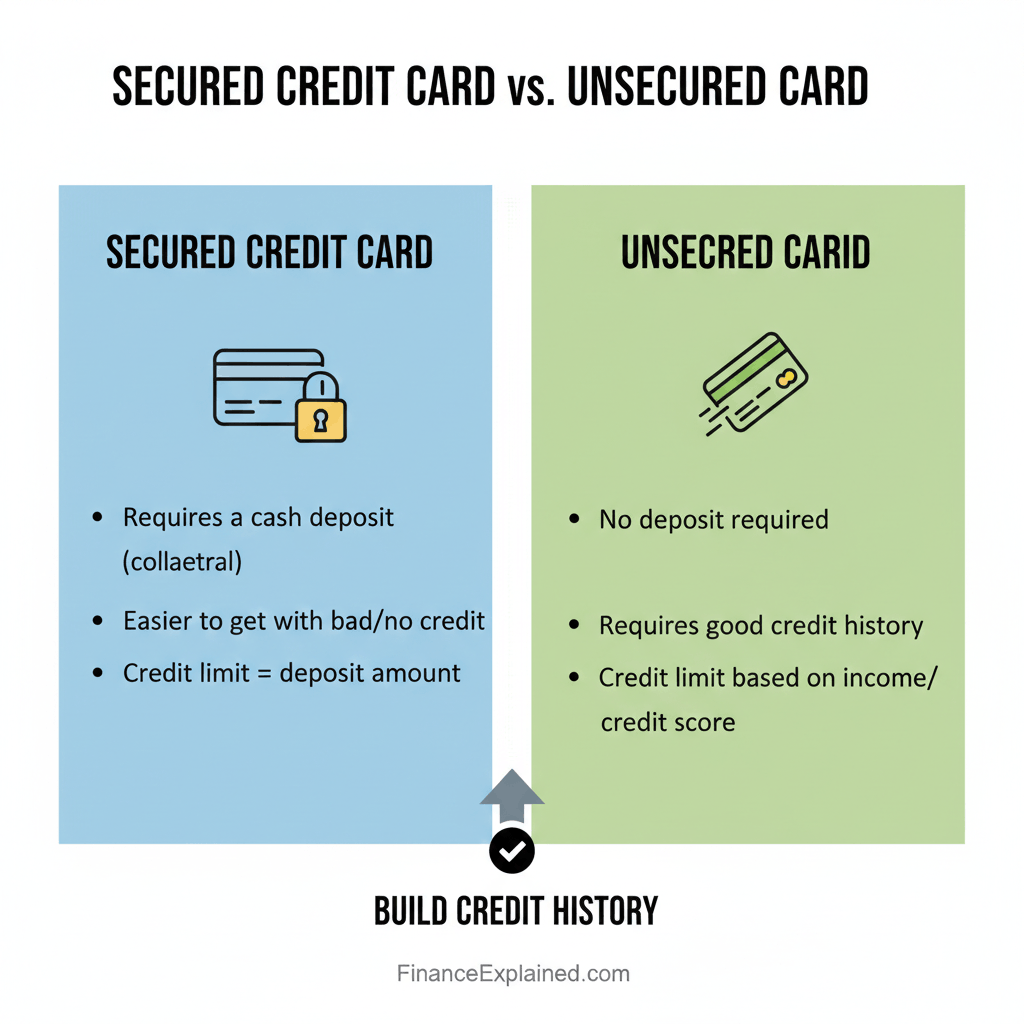
A secured credit card uses a refundable security deposit credit card model. You provide money upfront, and that deposit reduces the lender’s risk level secured credit cards represent. In many cases, the secured credit card limit equal deposit rule applies, so your deposit becomes your credit limit or closely matches it.
An unsecured credit card is an unsecured credit card without collateral. There is no deposit credit cards category here because you are not posting cash as security. The lender takes more lender risk unsecured credit cards involve, so they rely more on your profile and your unsecured credit card approval criteria.
That’s the core difference between secured and unsecured credit cards. Everything else—fees, rewards, limits—flows from that risk setup.
Secured credit card meaning and how secured credit cards work
Secured credit card meaning is simple: it is a credit card backed by a deposit.
Secured credit card deposit requirement and collateral basics
A secured credit card deposit requirement is usually a fixed amount you pay upfront. Many issuers treat it as a refundable security deposit credit card arrangement. If you close the account in good standing, you can often get the deposit back.
This is the secured credit card collateral requirement in practice. The deposit exists to reduce default risk and make the product available to people with weaker credit profiles.
Credit limit on secured credit cards
Credit limit on secured credit cards is often closely tied to the deposit. Many cards follow a secured credit card limit equal deposit pattern. Put down $200, get a $200 limit. Put down $500, get a $500 limit. Not every issuer is identical, yet that is the common structure.
This matters because a small limit makes daily spending feel risky for credit reporting. A $200 limit can be maxed out by normal groceries and fuel, even if you pay in full later. That is why credit utilization secured vs unsecured becomes a deciding factor.
Secured credit card safety and lender risk
People sometimes think secured means “safer” for the consumer. Secured credit card safety is mostly about accessibility and control, not about protections. It is safer in the sense that you can start small and keep limits tight while you learn habits.
The bank’s side is clear: the deposit lowers the risk level secured credit cards carry. That is why approval odds secured vs unsecured credit cards often favor secured products for beginners.
Unsecured credit card meaning and how unsecured credit cards work
Unsecured credit card meaning: a credit card issued without a deposit.
No deposit credit cards and lender risk
No deposit credit cards exist because the lender is willing to take the risk based on your profile. That is why lender risk unsecured credit cards comes up in approvals. The lender reviews your credit history, income, debts, and past behavior to decide if you qualify.
Unsecured credit card default risk is part of the pricing too. If a lender believes risk is higher, limits may be lower and interest rates secured vs unsecured credit cards can tilt higher on the unsecured side for that borrower.
Unsecured credit card credit limit and borrowing power
Unsecured credit card credit limit is often higher than what you see on a starter secured card, especially once you reach fair-to-good credit. That higher unsecured credit card borrowing power can help with utilization, because your balance becomes a smaller percentage of your limit.
This does not mean you should spend more. It simply means normal spending is less likely to create a utilization spike.
Approval odds: secured vs unsecured
Approval odds secured vs unsecured credit cards are different because of how each product is structured.
Secured credit card eligibility requirements and application process
Secured credit card eligibility requirements are usually easier. A secured credit card application process often focuses on identity checks, ability to fund the deposit, and basic banking history. Some issuers still check credit, yet many secured cards are built for people rebuilding credit.
That makes secured cards popular for:
- Best credit cards for bad credit shoppers
- Credit cards for no credit history
- People rebuilding credit score with secured cards after late payments or collections
Unsecured credit card eligibility requirements and approval criteria
Unsecured credit card eligibility requirements tend to be stricter. Unsecured credit card approval criteria usually center on existing credit history, payment patterns, utilization history, and overall debt load.
Unsecured cards for good credit are easier to qualify for once you already have established accounts reporting well. Unsecured credit card for experienced users often fits people who have already handled revolving credit responsibly.
Credit utilization secured vs unsecured and why limits change the outcome
Credit utilization secured vs unsecured is one of the most important practical differences in day-to-day credit building.
A small limit makes your credit usage percentage rise quickly. If you have a $300 secured limit and your statement reports a $150 balance, that looks like 50 percent utilization. On an unsecured card with a $3,000 limit, that same $150 balance looks like 5 percent utilization.
That is why a secured card can feel slower to build credit unless you use it with a plan.
Ideal credit usage percentage on a low limit
People often hear “keep utilization low” and assume it is easy. On a low limit, it requires timing.
If you are using a secured card with a small limit:
- Pay before the statement closes, not only on the due date
- Make smaller payments during the month so the reported balance stays low
- Keep charges predictable so you do not accidentally report a high number
Those habits are part of secured credit card best practices, and they make the card behave like a strong credit-building tool instead of a score drag.
Reporting to credit bureaus and credit building speed
Reporting is the part that many people miss.
Reporting to credit bureaus secured cards is not automatic across every product. Unsecured credit card credit reporting is also not guaranteed for every niche product. Before choosing, confirm the card reports to at least one major bureau, and ideally all three.
A card that does not report cannot help with rebuilding credit score with secured cards, and it will not serve as one of your credit building credit cards.
What reporting actually does for you
When a card reports, it adds data to your file:
- Payment history entries
- Balance and limit entries that feed utilization
- Account age entries that help over time
Those are the same signals for secured and unsecured cards. That is why impact on credit score secured vs unsecured is mostly driven by behavior and reporting, not by the card label.
Secured credit card pros and cons
A secured credit card pros and cons view is the most useful way to decide.
Secured credit card advantages
Secured credit card advantages often include:
- Better approval odds when you have no credit history
- A clear starting point for rebuilding credit score with secured cards
- A controlled limit that can help you learn spending boundaries
- A deposit that is often refundable
A secured credit card for credit repair can make sense when you have limited options and need reporting activity to restart momentum.
Secured credit card disadvantages
Secured credit card disadvantages usually show up in cost and flexibility:
- The deposit ties up cash
- Limits can be low, making utilization harder
- Some secured products carry secured credit card fees that do not feel worth it
- Some issuers do not offer an easy graduation path
This is why choosing between secured and unsecured credit cards is not only about approval. It is also about how the product behaves after approval.
Unsecured credit card pros and cons
Unsecured credit card advantages
Unsecured credit card advantages often include:
- No deposit required
- Higher limits if you qualify
- More reward options, including cashback unsecured credit cards
- More room to manage utilization with normal spending
Unsecured credit card rewards can be attractive once you already have control of payments and balances. Rewards are not the main goal during rebuilding, yet they can be a nice extra for experienced users.
Unsecured credit card disadvantages
Unsecured credit card disadvantages are mostly about qualification and risk:
- Harder approvals without history
- Higher rates for weaker profiles
- A higher limit can tempt overspending if you do not have strong habits
Unsecured credit card default risk is not only a lender concern. It can become a consumer problem if spending grows faster than repayment ability.
Fees and APR: the real cost of each card
Fees are where many people get burned, especially when searching best credit cards for bad credit.
Secured credit card fees and annual fee secured credit card traps
Secured credit card fees vary a lot by issuer. Some secured cards have no annual fee. Some charge an annual fee secured credit card cost that makes the product expensive for what it is.
When fees are too high, the card becomes a slow, frustrating way to rebuild. You can still build credit, yet you pay more than necessary.
Unsecured credit card fees and cost patterns
Unsecured credit card fees also vary. Some unsecured cards for good credit come with no annual fee and solid rewards. Unsecured products aimed at rebuilding can have high fees, high rates, or both.
Interest rates secured vs unsecured credit cards and APR comparison secured unsecured
Interest rates secured vs unsecured credit cards are not always predictable. Some secured cards still have high APRs. Some unsecured cards can have lower APRs if your credit is already strong.
APR comparison secured unsecured matters most if you carry balances. If you pay in full each month, APR matters less because interest is usually avoided.
Still, a secured credit card interest rate and unsecured credit card interest rate can become relevant during emergencies, so it is worth checking before you apply.
Rewards: do they matter while building credit?
Unsecured credit card rewards and cashback unsecured credit cards are common selling points. Secured credit card rewards availability exists in some products, yet rewards are not consistent in the secured category.
If you are focused on rebuilding, rewards should never push you into spending more or carrying balances. A clean credit record beats points every time. A small amount of cashback is not worth a reported high balance or a missed payment.
A practical rule:
- Beginners: focus on reporting, payments, and utilization control
- Experienced users: rewards can be part of the decision if habits are stable
That distinction fits secured credit card for beginners vs unsecured credit card for experienced users.
Who should choose secured vs unsecured credit cards
Choosing between secured and unsecured credit cards is easier when you start with your current profile, not the “ideal” card.
Credit cards for no credit history and beginners
If you have no credit history, a secured credit card for beginners often makes sense because approval odds are usually higher, and the product is designed to help you start reporting.
In this situation, the “fastest” builder is often the one you can get approved for now, use responsibly, and keep clean for several months.
Best credit cards for bad credit and credit repair
If you are rebuilding, a secured credit card for credit repair is often more realistic than trying to get approved for unsecured credit cards immediately.
Rebuilding credit score with secured cards works when:
- The card reports to bureaus
- You keep credit utilization low
- You pay on time, every time
- You avoid stacking new applications
Unsecured cards for good credit and experienced users
If your profile already supports unsecured cards for good credit, an unsecured card can be a clean pick. Higher limits make utilization easier, and rewards may be available with fewer fees.
Unsecured credit card for experienced users often fits someone who already knows how to use revolving credit without carrying high balances.
Secured credit card graduation to unsecured: what it means and how it works
Secured credit card graduation to unsecured is the point where your issuer returns your deposit and converts the account to an unsecured card, or offers you an upgrade path to a new unsecured product.
Upgrading secured to unsecured credit card options depend on the issuer. Some automatically review your account after months of on-time payments. Some require a request. Some do not offer graduation at all.
Signals that you are ready for graduation
Most people are closer than they think. A few signals commonly line up with graduation readiness:
- Multiple months of on-time payments
- Low reported balances month after month
- No new negative entries on your report
- Stable use that shows you can handle the account
Graduation can help in two ways: it frees your deposit and may increase your limit, which supports better utilization control.
Should you close the secured card after graduation?
If the secured card graduates into an unsecured card, keeping it open can help account age. If you are moving to a different unsecured product, closing the secured card too quickly can reduce available credit and raise utilization.
The best move depends on fees. If the card has an annual fee secured credit card cost, you might not want to keep it long term. If it has no annual fee and it reports well, keeping it can help your profile.
Secured credit card best practices and unsecured credit card best practices
The habits that build credit are simple. They are also easy to mess up when limits are small or spending is emotional.
Keep reported balances low
Credit utilization secured vs unsecured is easier to control with a higher limit, yet it is possible on either card with timing.
A clean method:
- Use the card lightly during the month
- Make a payment before the statement closes
- Let a small amount report, then pay it off by the due date
This keeps the reported balance from spiking.
Pay on time without relying on memory
Late payments reported to bureaus are difficult to undo. Autopay for at least the minimum protects you from missed payments. Then you can pay extra manually.
Do not apply for multiple cards at once
A string of new applications can create a messy short-term profile. One good starter card used well often beats three cards used inconsistently.
Use the card like a tool, not extra income
The biggest credit-building mistake is treating a credit limit as spending power. A limit is not a budget. It is a trust line.
Secured credit card alternatives and unsecured credit card alternatives
Not everyone wants to post a deposit. Not everyone can qualify for a decent unsecured card immediately.
Secured credit card alternatives can include other credit-building products or approaches that still report positive payment data. Unsecured credit card alternatives may include starting with a simpler product through an existing bank relationship or waiting until your report is cleaner.
The right alternative is the one that reports, fits your budget, and does not pull you into high fees.
Common myths in secured vs unsecured credit cards comparison
A few myths keep people stuck.
“Secured cards build credit faster than unsecured cards”
Secured cards can start faster for beginners because approval is easier. Once you have a card that reports, both types can build at a similar pace. Behavior and reporting drive the result.
“You must carry a balance to build credit”
Carrying a balance is not required. Reporting a balance is different from carrying it past the due date. You can pay in full and still show activity.
“Rewards matter most”
Rewards only matter after the basics are stable. Payments and utilization control have a bigger impact than points.
Conclusion
Secured credit card vs unsecured credit card is not a race between two products. It is a choice between two starting points. A secured card can be the fastest path when you need approval odds secured vs unsecured credit cards to work in your favor, or when you have credit cards for no credit history and need reporting to begin. An unsecured card can feel faster when you qualify for a higher unsecured credit card credit limit that keeps credit utilization secured vs unsecured easier to manage. Pick the card that reports, fits your budget, keeps fees reasonable, and supports secured credit card graduation to unsecured when you are ready.


