

Budget Categories List: What to Include (With a Simple Template)
A Budget Categories List is the part of budgeting that decides whether your plan feels calm or chaotic. People often start a budget with good intentions, then get frustrated because the numbers never match real life. Most of the time, the issue is not motivation. It’s missing categories, messy expense classification, or categories that are too vague to track.
A clean budgeting categories list gives your money a structure. It helps with budget planning, money management, and financial planning because it shows where cash goes in a way you can measure. It also makes expense tracking and budget tracking easier, since every purchase has a “home” inside your budget structure.
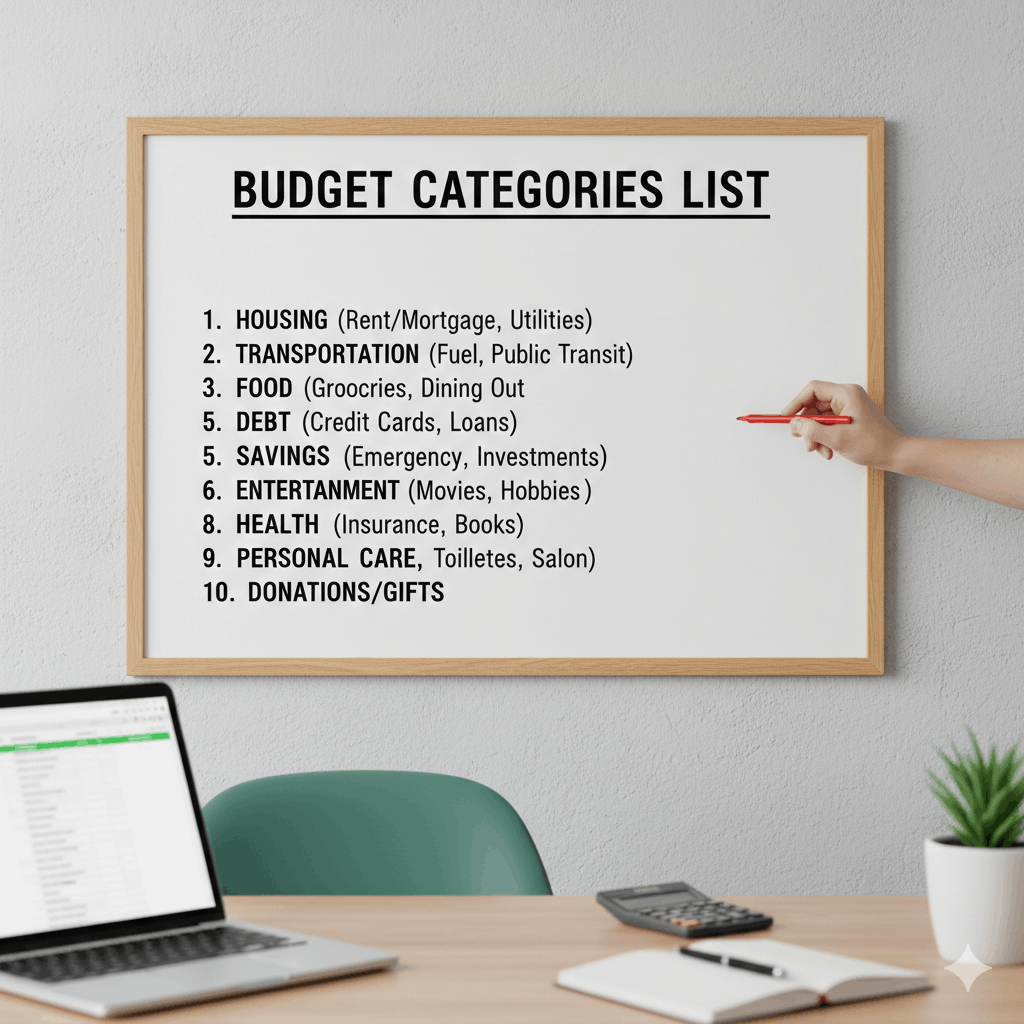
This guide gives you a complete Budget Categories List, explains how to set up income categories, breaks down fixed expenses and variable expenses, and shows how to handle discretionary expenses, monthly expenses, and annual expenses. You’ll also get a copy-ready template for budget worksheet categories and budget spreadsheet categories, plus a simple way to decide between simple budget categories and detailed budget categories. Toward the end, you’ll see how the list changes for household budget categories, home budget planning, and a family budget, plus how categories work in zero-based budget categories and envelope budgeting categories.
What a Budget Categories List does inside your budget framework
A budget categories list is a set of spending categories and financial categories you use to organize money. It’s the map behind your budget breakdown. If you already track spending in an app or spreadsheet, you already have categories in some form. The difference is whether your categories support clear expense classification and steady budget allocation.
A strong budget framework does three jobs at once.
It creates budget organization so you can see where money goes.
It supports expense management by turning messy spending into clear cost categories.
It makes money allocation easier, since you can plan limits for each area.
That is why personal finance categories matter. They turn “I think I spend too much” into “I’m going over in dining and shopping, so I’ll adjust those categories this week.”
Start with income categories before you list expenses
Many people jump straight into expense categories and forget the income side. Income categories matter because they shape your cash flow categories. Even when total monthly income looks fine, timing can cause stress if pay days and bill due dates don’t line up.
Add income categories at the top of your budget breakdown. Keep them simple.
Common income categories
Salary or wages (take-home)
Freelance or contract income
Business income
Tips or commissions
Support from family
Benefits or stipends
Other income (refunds, one-time payments)
If your income changes month to month, write a conservative estimate for budget planning. This keeps your budget structure realistic.
A quick note on cash flow categories
Cash flow categories are not a separate list. They are a way to think about timing. If most income arrives weekly, your grocery and transport categories should be split weekly. If income arrives twice a month, split variable expenses across the two pay cycles. This keeps budget tracking steady and reduces mid-month shortfalls.
Expense classification that keeps budgeting clear
Expense classification is the skill that makes categories work. Without it, everything feels like one big pile of monthly expenses.
You will see four common labels used in budget categories:
Fixed expenses
Variable expenses
Discretionary expenses
Must-pay expenses and optional expenses
Some people also use the terms non-essential expenses and essential expenses. If you prefer that style, treat “must-pay” as the meaning, then keep moving. The label matters less than the decision.
Fixed expenses
Fixed expenses are the costs that stay close to the same each month. They form the base of your budget framework.
Rent or mortgage
Loan payments
Insurance premiums
Phone plan
Internet
Childcare payments
Subscription services you keep
Fixed expenses are easier to plan, so they go first in budget allocation.
Variable expenses
Variable expenses change month to month and week to week. These categories are where most budgets drift.
Groceries
Fuel and transport
Utilities that fluctuate
Household supplies
Medical and pharmacy spending
School supplies
Personal spending
Variable expenses need frequent expense tracking, since they can creep up without noticing.
Discretionary expenses
Discretionary expenses are optional lifestyle spending. This does not mean they are “bad.” It means they can be reduced when needed.
Dining out
Coffee and snacks
Streaming and entertainment
Hobbies
Shopping and upgrades
Weekend activities
A clean list separates discretionary expenses from must-pay expenses so you can see where you have room.
Must-pay expenses and optional expenses
Some people like a simple split: must-pay expenses and optional expenses. That split works well for budgeting for beginners because it reduces overthinking.
Must-pay expenses include housing, utilities, transport to work, insurance, and minimum debt payments.
Optional expenses include dining, entertainment, and shopping upgrades.
You can use this split alongside fixed and variable expenses. One is about obligation, the other is about predictability.
Monthly expenses vs annual expenses: the categories people miss
Budgets often break because annual expenses get ignored. A budget that only covers monthly bills will feel “fine” until something predictable shows up: insurance renewals, vehicle registration, back-to-school shopping, or a medical bill.
A practical budgeting system treats annual expenses as part of monthly expense allocation by spreading them out. This is sometimes called a sinking fund approach, though you don’t need special terms to do it.
Take an annual expense, divide by 12, and assign that amount monthly.
Car maintenance and repairs
Annual subscriptions
Gifts and holidays
Home repairs
School fees and uniforms
Travel savings
This approach supports expense management because it prevents “surprise” costs from wrecking budget tracking.
Budget Categories List: the core categories most people use
There is no single perfect budgeting categories list. Still, most budgets share the same core because most households pay for the same main needs.
One widely cited consumer spending breakdown shows housing, transportation, and food take a large share of spending for many households, which explains why these categories usually sit at the top of a budget. Use that as a reality check while building your own list.
Start with these core budget categories, then tailor.
Housing and home costs
Rent or mortgage
Utilities (electric, gas, water)
Internet
Home maintenance
Renters or home insurance
Property taxes (if not in mortgage)
Transportation
Fuel
Public transit
Car payment
Car insurance
Maintenance fund
Parking and tolls
Food
Groceries
Dining out
Work lunches
Health and wellness
Health insurance (if not already listed)
Medicines and pharmacy
Doctor visits
Gym or fitness (optional, based on your life)
Debt payments
Credit card minimum payments
Loan payments (student, personal, auto if not already listed)
Extra payoff (separate line if you are focusing on payoff)
Savings and goals
Emergency fund
Short-term savings goals
Long-term savings goals
Personal spending
Clothing
Haircuts and personal care
Gifts
Hobbies
Household supplies
Cleaning supplies
Toiletries
Small home items
Irregular expenses fund
Annual renewals
Car repairs beyond routine
Medical surprises
Home repairs
Buffer
A small cushion line for the month
A buffer category is one of the easiest ways to keep budget tracking stable. It also makes budget adjustment easier when a variable category goes over.
Simple budget categories: a starter list that stays easy to track
Many people start with too many spending categories, then stop tracking because it feels like work. A starter list should be simple budget categories that cover your whole life without too much detail.
This works well for personal budget categories and monthly budget categories, especially in month one.
Housing and bills
Food
Transport
Health
Debt payments
Savings
Personal spending
Household supplies
Irregular expenses
Buffer
You can run a full budgeting system on this list. It covers expense categories, it supports expense tracking, and it gives a clear budget structure.
Detailed budget categories: when splitting categories helps
Detailed budget categories are useful when one area keeps going over and you want better spending control. Splitting categories is not about complexity for its own sake. It’s about clarity.
Split a category when the “why” matters.
Groceries vs dining out
Fuel vs car maintenance
Subscriptions vs entertainment outings
Personal care vs clothing
Kids school costs vs kids activities
Medical visits vs pharmacy
A detailed list helps with expense classification. It also helps with budget allocation because you can set a limit for the part that keeps drifting.
Personal budget categories: a clean list for one person
Personal budget categories should match how you actually spend. A single person may have fewer shared household lines and more personal choices.
A practical personal finance categories list:
Income
Salary or wages
Other income
Fixed expenses
Rent
Internet and phone
Insurance
Loan payments
Subscriptions you keep
Variable expenses
Groceries
Dining out
Fuel and transport
Utilities that vary
Household supplies
Medical and pharmacy
Discretionary expenses
Entertainment
Shopping
Hobbies
Personal care upgrades
Savings and goals
Emergency fund
Short-term goals
Long-term goals
Irregular expenses and buffer
Annual expenses fund
Buffer
If you plan with a spreadsheet, this becomes a clear budget spreadsheet categories setup. If you prefer paper, it becomes a clean set of budget worksheet categories.
Household budget categories: shared bills without confusion
Household budget categories work best when shared spending and personal spending are both visible. Many couples fight about money because shared bills are mixed with personal choices, which hides the real pattern.
For home budget planning, use these sections:
Shared income categories
Income from person A
Income from person B
Other income
Shared fixed expenses
Housing
Utilities
Internet and phones
Insurance
Minimum debt payments
Shared variable expenses
Groceries
Household supplies
Transport
Shared subscriptions
Personal spending categories
Personal spending for person A
Personal spending for person B
This line reduces stress because it creates a clear boundary. It also supports budget accountability without arguments over small purchases.
Shared goals and savings
Emergency fund
Savings goals
Extra debt payoff
Irregular expenses and buffer
Annual expenses fund
Buffer
That is a budget organization structure that works across different incomes and spending styles.
Family budget categories: what to add for kids and a busy household
A family budget usually needs more spending categories because life has more moving parts. Still, you can keep it readable.
Start with the household budget categories list, then add:
Childcare
School fees and supplies
Kids activities
Kids clothing
Medical and pharmacy for children
Family transport costs
Family fun category
If the list feels long, merge a few lines. A single “kids” category can work, then split later if needed.
Budget allocation: how to fund categories in the right order
A list is only helpful if you know how to fund it. Budget allocation is the order you assign money to categories.
A simple order that works for many people:
Income categories total
Fixed expenses first
Must-pay variable expenses (groceries, fuel, utilities)
Debt minimum payments
Savings goals
Discretionary expenses
Irregular expenses fund
Buffer
This order supports financial planning because it protects stability first, then builds progress toward goals.
Zero-based budget categories: how categories work when every dollar is assigned
Zero-based budget categories are not a different list of categories. They are the same expense categories and spending categories, used in a stricter budgeting system.
In a zero-based budget, you assign every dollar until the remaining number is zero. That means savings and debt payoff lines are funded on purpose, not left to chance.
A clean zero-based budgeting categories list often includes:
Income categories
Fixed expenses
Variable expenses
Discretionary expenses
Debt payments (minimum and extra)
Savings goals
Irregular expenses fund
Buffer
The difference is in the process. Every category gets a planned amount, and the plan totals to income. That supports strong budget accountability.
Envelope budgeting categories: how to label categories for cash limits
Envelope budgeting categories work well for people who overspend in a few areas. The idea is simple: set an amount for each category, then treat that amount as the limit for the month or week.
Envelope budgeting categories often include:
Groceries
Dining
Fuel
Personal spending
Kids activities
Household supplies
If you use digital envelopes, the same idea applies. The system supports spending control by making limits visible in real time.
Budget worksheet categories and budget spreadsheet categories: a simple template
A template should be copy-ready and easy to read. This one works for a budget worksheet and a budget spreadsheet.
The simple template layout
Top section: income categories
Middle sections: spending categories, split into fixed expenses and variable expenses
Lower section: savings goals, debt payoff, irregular expenses, buffer
Columns:
Category
Planned
Actual
Difference
Notes (optional)
A copy-ready example structure
Income categories
Salary or wages
Other income
Fixed expenses
Housing
Utilities
Internet and phone
Insurance
Debt minimum payments
Subscriptions
Variable expenses
Groceries
Fuel and transport
Household supplies
Medical and pharmacy
Personal spending
Dining out
Savings and goals
Emergency fund
Short-term goal
Long-term goal
Extra debt payoff
Annual expenses
Annual expenses fund
Buffer
Buffer
Totals
Total income
Total planned spending
Total actual spending
Left to assign (or remaining)
If you run a zero-based budget, your planned left to assign should be zero.
This template supports budget tracking because it keeps planned and actual side by side. It also improves expense management because it forces expense classification.
Expense tracking: the routine that makes categories useful
You can have the best budgeting categories list on the planet, then still overspend if you never check it. Expense tracking is what turns categories into real control.
A simple weekly routine works for many people:
Pick one day each week.
Review variable expenses and discretionary expenses first.
Compare actual vs planned.
Make a budget adjustment right away if a category is running high.
This is budget tracking that stays light. It also protects cash flow categories, since you can spot a problem before the month ends.
Budget tracking and budget adjustment without stress
Budget adjustment means moving money between categories so your totals still make sense.
Example:
Dining out goes over by 25.
Reduce entertainment by 15.
Reduce buffer by 10.
Now the budget stays balanced.
This is a normal part of budget planning. It’s also a practical form of financial control, since you are deciding where money comes from instead of guessing later.
How many budget categories should you have?
People often ask for a perfect number. The better answer is a range based on how you track.
If you want simple budget categories, aim for 10 to 15 categories.
If you want detailed budget categories, aim for 20 to 35 categories.
More than that can work, though tracking becomes harder unless you enjoy detail.
A simple rule: start simple, then split only the categories you keep overspending in. That gives you better expense classification without turning budgeting into a chore.
Common category mistakes that make budgets feel inaccurate
Mixing income and expenses in the same section
Income categories should be separate at the top. This keeps the budget breakdown clean.
Forgetting annual expenses
Annual expenses are one of the main reasons budgets fail. Add a monthly fund line for them.
Treating every purchase as “miscellaneous”
A misc category can exist, though it should stay small. If it grows, it usually means your spending categories list needs one new category.
Making categories that are too narrow too early
Too many tiny categories makes tracking feel heavy. Start broad, then refine.
Closing section
A Budget Categories List is not just a list. It’s the foundation of your budget structure. It supports budget organization, clearer expense classification, and better money allocation because every category represents a real part of life. When you choose the right mix of simple budget categories and detailed budget categories, your budgeting system becomes easier to follow.
Start with income categories, split fixed expenses and variable expenses, give discretionary expenses clear limits, and add a line for annual expenses. Then track weekly and adjust when needed. That’s how a budgeting categories list turns into real money management.


