

Tax Brackets Explained Without the Confusing Math
Taxes feel confusing for one main reason: people mix up tax brackets with the rate on every dollar they earn. This guide is tax brackets explained in a calm, plain-English way, so you can understand the progressive tax system, the difference between marginal tax rate and effective tax rate, and how tax rates by income really work.
If you’ve ever worried that moving into a higher tax bracket will “make you lose money,” you’re not alone. That fear comes from a misunderstanding of tax bracket thresholds and tax rate bands. Once you see how the tax slab system works, the panic goes away.
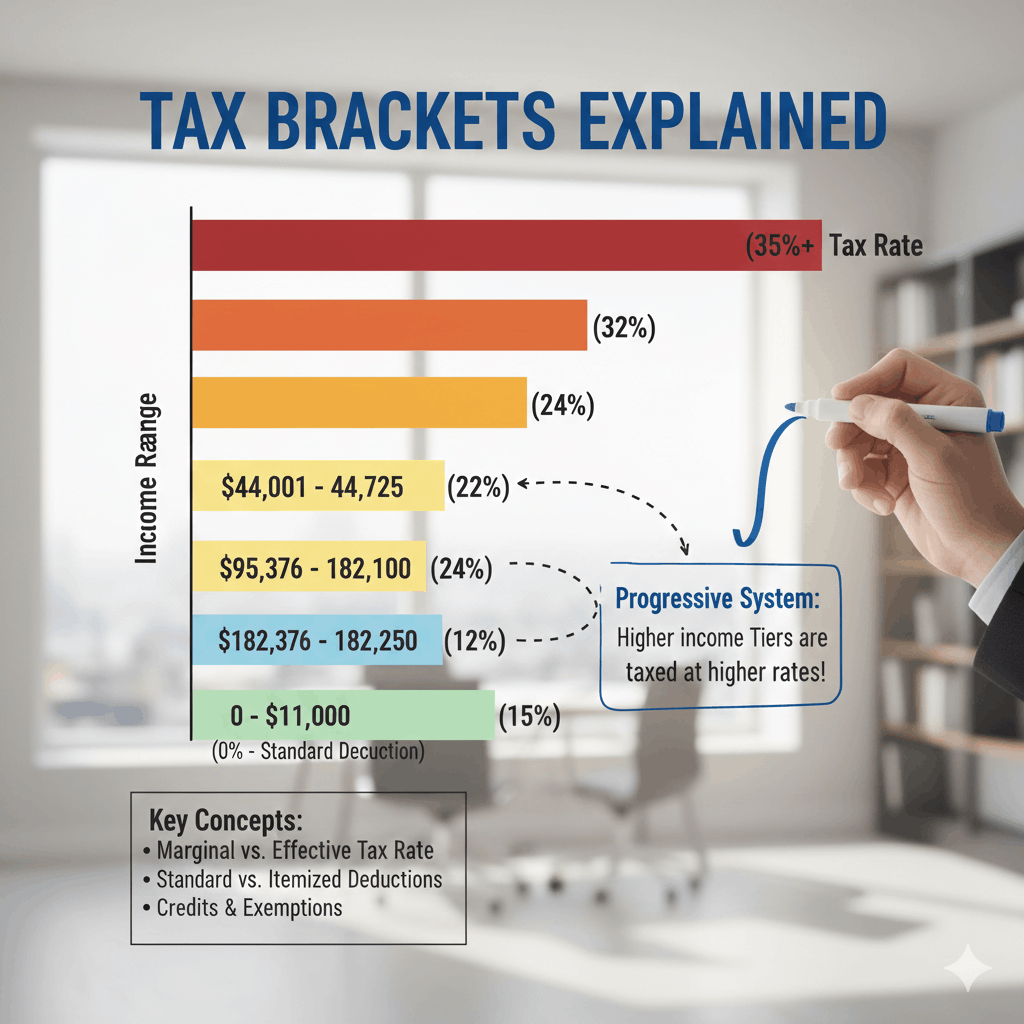
Tax brackets, in plain English
Tax brackets are slices of income. Each slice gets its own tax bracket percentage. You move up the slices as income rises. Your total tax is the sum of the tax on each slice.
Think of income tax brackets like a staircase:
- The first steps are taxed at lower rates.
- Higher steps are taxed at higher rates.
- You only pay the higher rate on the dollars that land on those higher steps.
That is the core of how tax brackets work inside a progressive income tax system. It’s not one flat rate across your paycheck. It’s layered.
The words that cause most confusion
Tax bracket explained
When someone says, “I’m in the 22% bracket,” they’re talking about their top slice. That number is a marginal tax rate, not their overall rate.
Tax bracket chart
A tax bracket chart shows rates and tax bracket income ranges. People often glance at one row and assume it applies to all their income. It doesn’t.
Tax bracket limits and tax bracket thresholds
Tax bracket limits are the edges of each slice. Tax bracket thresholds are the starting points where a new rate begins.
Progressive tax system vs a flat tax, without the debate
A progressive tax system uses increasing rates as income rises. A flat tax uses one rate for all taxable income levels.
Progressive systems aim to collect a larger share from higher incomes. The tradeoff is complexity: you need tax calculation by bracket to see your real outcome.
You do not need advanced math to understand it. You need the right mental picture: slices, not a single rate.
Marginal tax rate vs effective tax rate
These two terms show up in every “tax brackets explained” conversation.
Marginal tax rate
Marginal tax rate is the rate on the next dollar you earn. It matches the highest bracket slice your taxable income reaches.
If your taxable income touches the 22% bracket, your marginal tax rate is 22%. That does not mean you pay 22% on all income.
Effective tax rate
Effective tax rate is your total federal income tax divided by your total income (or sometimes taxable income, depending on how people calculate). It’s your average rate across all slices.
Most people have an effective tax rate lower than their marginal tax rate. That’s normal in a progressive tax system.
A quick way to remember it
Marginal rate answers: “What rate hits my next dollar?”
Effective rate answers: “What rate did my whole year average out to?”
Taxable income levels: the part that decides your bracket
Many people search “how much tax do I pay” and start with salary. Salary alone is not the number that lands in income tax brackets.
Your brackets are based on taxable income levels, not your gross pay.
The simple flow
- Start with total income (wages, business income, interest, and more)
- Subtract adjustments (these vary by situation) to reach adjusted gross income
- Subtract deductions to reach taxable income
- Apply tax rates by income across the bracket slices
- Subtract credits (if eligible) to reach final tax liability
That’s tax liability calculation in normal language.
Standard deduction effect
Most filers use the standard deduction. It reduces taxable income levels before tax bracket calculation.
Standard deduction amounts change over time, and so do annual tax brackets. That’s why inflation-adjusted tax brackets matter. When people quote rates online, they may be quoting the wrong year.
Itemized deductions and tax brackets
Itemized deductions replace the standard deduction when itemizing is higher. Common itemized categories include mortgage interest, certain taxes, charitable gifts, and medical expenses over a threshold.
Itemizing can lower taxable income, which can move part of your income into lower rate bands. This is one of the cleanest examples of deductions and credits impact on bracket outcomes.
Income tax rates: how tax bracket percentages are layered
Federal tax brackets use multiple tax rate bands. The U.S. has several bracket percentages that apply step-by-step.
You can read a tax bracket chart as a set of “up to” ranges:
- Up to this amount: rate A
- Next range: rate B
- Next range: rate C
And so on.
That’s it. No trick.
Ordinary income tax brackets vs other brackets
Most of what people think of as “income” lands in ordinary income tax brackets:
- Wages
- Self-employment income
- Short-term investment gains
- Interest (often)
- Many types of retirement withdrawals
Some income types can follow different rules, which is why capital gains tax brackets exist.
Step-by-step tax calculation without heavy math
This section is for people who want tax brackets explained with a simple walkthrough. The goal is clarity, not precision down to the dollar. Tax software handles the exact numbers.
Step 1: Pick a round income
Assume someone earns $70,000 in wages.
Step 2: Get to taxable income
They subtract the standard deduction (or itemized deductions). Say their taxable income becomes $55,000 after deductions.
Step 3: Apply tax calculation by bracket
That $55,000 is not taxed at one rate. It’s split across bracket slices.
- The first slice gets the lowest rate.
- The next slice gets the next rate.
- The top slice gets the highest rate that their taxable income reaches.
This is the heart of marginal taxation.
Step 4: Read the result the right way
They will have:
- A marginal tax rate equal to the rate on the top slice
- An effective tax rate lower than that, since earlier slices were taxed at lower rates
This is why a raise that pushes part of income into a higher bracket does not mean all income is taxed higher.
The big misunderstanding: moving into a higher tax bracket
Let’s deal with the most common question directly.
Does higher income increase all taxes?
No. Higher income can increase total tax, since there are more dollars being taxed. It does not change the rate on the dollars that stay in lower bracket slices.
Only the part that crosses the new threshold gets the higher tax bracket percentage.
Tax bracket misconceptions that drive fear
Misconception 1: “If I cross into the next bracket, my whole paycheck gets hit”
That’s not how tax rate bands work.
Misconception 2: “I should avoid a raise”
Avoiding income to stay in a lower bracket is usually a bad trade. The extra income almost always outweighs the tax on the top slice.
Misconception 3: “Bonuses are taxed at a higher rate”
Bonuses can be withheld at a different rate by payroll systems. Withholding is not final tax. Final tax is based on your full-year taxable income and the bracket slices.
This confusion shows up again in withholding vs tax brackets.
Withholding vs tax brackets: why refunds confuse people
Many people judge their bracket by their paycheck. That leads to stress.
What withholding really is
Withholding is an estimate. Employers withhold based on your W-4 settings and payroll rules. It tries to match your expected tax liability calculation by year-end.
A refund often means too much withholding. A balance due often means too little withholding.
Refunds are not a prize from the IRS. They’re usually an overpayment.
Tax bracket impact on paycheck
If you get a raise or a bonus, your paycheck withholding can jump. That does not always mean your actual bracket changed. It often means the payroll system is trying to keep up with your expected annual income.
Estimated taxes and brackets
Estimated taxes matter for people who do not have enough withholding:
- Self-employed income
- Side income with no withholding
- Large investment income
- Some gig work
Estimated taxes and brackets go together because you still land in federal tax brackets, even without a traditional paycheck.
Self-employed tax brackets: a quick reality check
Self-employed tax brackets can feel harsher for one reason: self-employment income can trigger extra taxes outside federal income tax brackets (like self-employment tax).
This guide focuses on income tax brackets, yet self-employed readers should remember:
- You may owe income tax based on the same bracket slices
- You may also owe self-employment tax on net earnings
- Quarterly estimated payments are common
So the bracket piece is only part of your total tax burden by income.
Tax credits vs tax deductions: two different levers
A lot of “income tax planning” talk gets messy because credits and deductions do different things.
Tax deductions
Deductions reduce taxable income levels. That can reduce the amount of income exposed to higher bracket percentages.
Examples include the standard deduction effect, some retirement contributions, and certain itemized deductions.
Tax credits
Credits reduce tax after the bracket calculation. They reduce your tax bill dollar-for-dollar when you qualify.
So, tax credits vs tax deductions is simple:
- Deductions reduce the income that gets taxed
- Credits reduce the tax you owe
Deductions and credits impact results in different ways, and both can matter for tax bracket optimization.
Capital gains tax brackets: short-term vs long-term
Capital gains tax brackets create confusion, since they sound like the same brackets.
Short-term vs long-term capital gains tax
Short-term gains (assets held for a shorter period) are usually taxed like ordinary income. That means they often land in ordinary income tax brackets and follow the same bracket slices.
Long-term gains can follow different tax rate bands. This is one reason a tax bracket calculator can give different results depending on the type of income you enter.
This matters for people with brokerage accounts who want tax forecasting by bracket.
State tax brackets and combined rates
Federal tax brackets are only part of the story for many households.
State tax brackets
Some states use their own progressive income tax brackets. Some use a flat rate. Some have no wage income tax.
Combined federal and state tax rates
Your combined rate can be higher than the federal rate you see in a tax bracket chart. This is where people feel surprised, especially after moving to a new state.
When someone talks about “tax rates by income,” the real number can be federal plus state plus local, depending on where they live.
Annual tax brackets and inflation-adjusted changes
Tax bracket changes happen over time. Many systems adjust bracket thresholds each year for inflation. That helps prevent “bracket creep,” where inflation alone pushes people into higher slices.
When you read online posts, check the tax year. Annual tax brackets can shift. Tax bracket changes by year can be small, yet they still matter for withholding settings and planning.
Historical tax brackets
People sometimes bring up historical tax brackets to talk about policy shifts. That’s interesting, yet it rarely changes what you do this year. For most readers, the best move is understanding marginal taxation and using current thresholds.
Tax planning strategies tied to bracket logic
Tax planning strategies do not need to be fancy. The smartest moves usually focus on reducing taxable income legally, timing income and deductions where possible, and avoiding surprises.
Reducing taxable income
Common ways include:
- Using pre-tax deductions through retirement plans when available
- Using certain health-related accounts if eligible
- Taking deductions you qualify for, not deductions you wish existed
Reducing taxable income can keep more income in lower tax rate bands. It can also lower the top slice that hits higher bracket percentages.
Tax bracket optimization without games
Tax bracket optimization is often just good habits:
- Track income and deductions through the year
- Avoid guessing at withholding
- Review your filing status changes (marriage, children, dependents)
- Plan big income events when possible
Income tax planning for irregular income
If income swings, planning matters more:
- A large bonus year
- A commission-heavy year
- A business income spike
- A big stock sale
In those cases, tax forecasting by bracket can help you avoid a surprise bill.
Tools: tax bracket calculator and online tax bracket tools
Online tax bracket tools can help you estimate outcomes. Use them as rough forecasting tools, not as legal advice.
A tax bracket calculator is most useful when:
- You enter realistic deductions
- You separate ordinary income from capital gains
- You test “what if” scenarios for raises, side income, or retirement contributions
Online tools can miss details like phaseouts, special credits, or state rules. Still, they can help you understand how tax calculation by bracket behaves as income changes.
A simple checklist for “how much tax do I pay” questions
If you want a clean process without confusing math, do this:
- Estimate taxable income levels after deductions
- Identify your filing status, since single filer tax brackets, married filing jointly tax brackets, and head of household tax brackets have different thresholds
- Apply the bracket slices concept
- Separate withholding from final tax
- Account for credits if you qualify
That framework answers most bracket questions faster than memorizing tables.
Conclusion
Tax brackets explained without the stress come down to one idea: bracket percentages apply in slices, not across your whole income. The progressive tax system taxes early income at lower rates, then taxes the top slice at higher rates. Your marginal tax rate is your top slice rate. Your effective tax rate is your average across slices. Deductions reduce taxable income. Credits reduce the bill after the bracket math. Withholding is just an estimate. Once those pieces click, tax bracket myths lose their power.


