

Zero-Based Budget: What It Is and How to Start Today
A Zero-Based Budget is one of the cleanest ways to take control of your money fast. It works well for budgeting for beginners, families, and anyone who feels like their paycheck disappears without a clear reason. The idea is simple: you plan where every dollar goes before the month plays out. When the plan is finished, there is no “mystery money” left floating around. Your income has been assigned on purpose.
That single shift changes everything. It turns personal finance budgeting into a clear money management system. It gives you spending control without guessing. It creates budget accountability without needing complicated tools. It helps with debt payoff budgeting, savings-focused budgeting, and emergency fund budgeting, even when money feels tight.
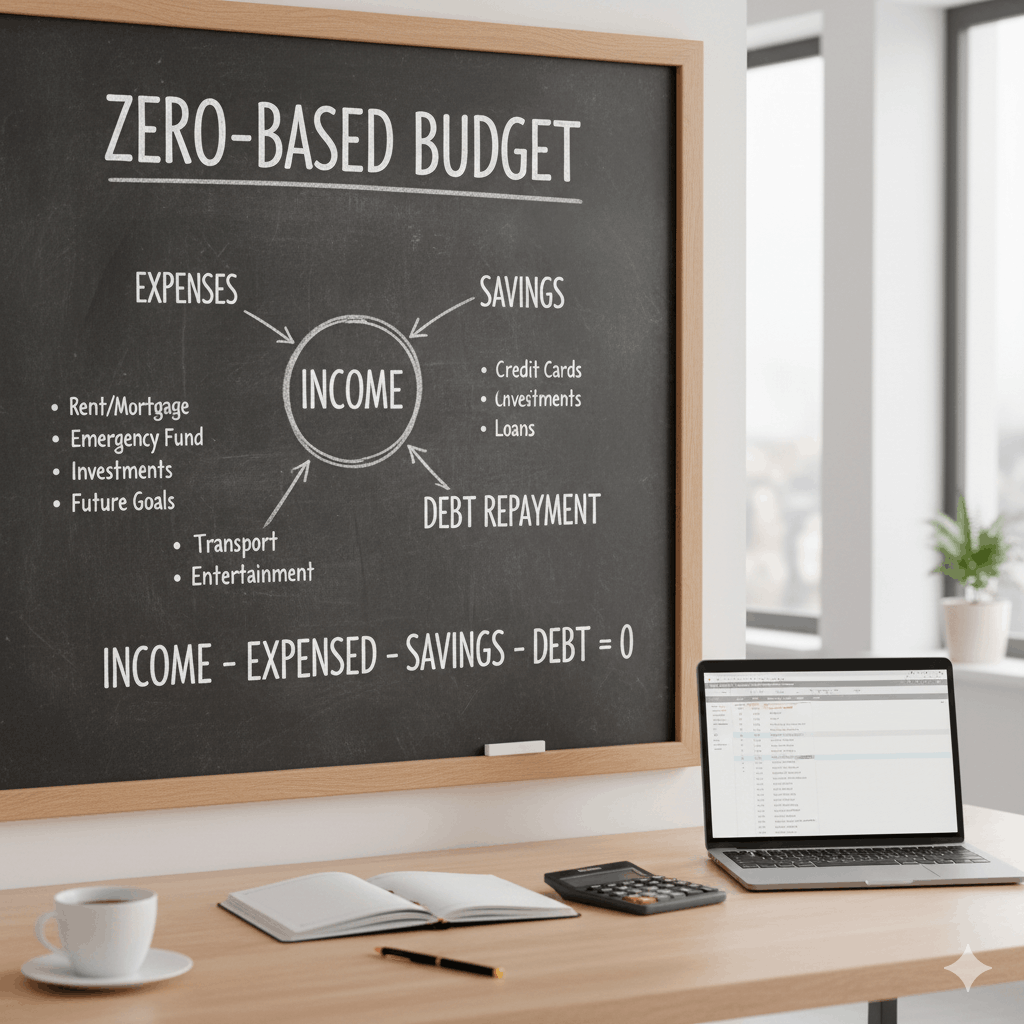
This guide explains the Zero-Based Budget in plain language, then shows you how to build one today. You will see the zero-based budgeting process step by step, a zero-based budgeting example you can copy, a zero-based budgeting template, and a zero-based budgeting worksheet layout you can use in a spreadsheet or on paper. You will learn how to do income minus expenses budgeting, how to assign every dollar, and how to keep the plan working through expense tracking and budget adjustment.
Intent
People searching Zero-Based Budget usually want one outcome: a budgeting method they can start now that actually holds up in real life.
The search intent often includes these goals:
A clear definition of zero-based budgeting and how the zero-based budget method works.
A step-by-step zero-based budget planning guide that makes it easy to budget from zero.
A practical zero-based budgeting system with budget categories planning, fixed and variable expenses, and monthly expense allocation.
Real examples, a zero-based budgeting example for a single person, a household budgeting example, and a paycheck budgeting example.
A simple way to stay consistent through expense tracking, budget adjustment, budgeting discipline, and budget accountability.
A comparison of zero-based budget vs traditional budget, including budgeting without carryover.
A few numbers that show why this method helps
Many people feel squeezed by a mix of rising living costs and expensive debt. Credit card interest often sits in the high teens or above 20 percent, which makes debt repayment budgeting more urgent for anyone carrying a balance. Many households report living paycheck to paycheck, which means one surprise bill can cause stress. A Zero-Based Budget is built for this reality because it creates a plan for every dollar and reduces the chances of drift.
Think of these numbers as context, not pressure. The goal is financial control and financial organization. The plan should feel usable, not strict.
What is a Zero-Based Budget?
A Zero-Based Budget is a monthly budgeting method where you assign every dollar of your take-home income to a category until the remaining amount is zero. This approach is often called zero-based budgeting or every dollar budgeting.
Zero does not mean you spend everything. Zero means every dollar has a job.
Some dollars pay bills.
Some dollars cover groceries and transport.
Some dollars go into emergency fund budgeting.
Some dollars go toward debt payoff budgeting.
Some dollars sit in a small buffer category.
When your income has been fully assigned, the budget line reads “left to assign: 0.” That is income minus expenses budgeting in action.
Why it’s called “budget from zero”
A traditional budget often starts with last month’s numbers and rolls them forward. A Zero-Based Budget starts fresh each month. You build the plan from zero based on the income you expect and the expenses you expect. That reset is part of the zero-based budgeting strategy. It keeps your plan tied to the month in front of you.
Why this is an expense-based budgeting approach
Expense-based budgeting means you plan from the ground up. You begin with real expenses and real goals. You do not rely on “leftover money” as the savings plan. Savings becomes a planned line. Debt payoff becomes a planned line. This is why many people see better spending control with the zero-based budgeting system.
How the zero-based budget method works
The zero-based budget method follows one rule:
Income – planned allocations = 0
Planned allocations include every expense category and every goal category.
If your income is 3,000, you assign 3,000 across categories until the final remaining number is zero.
This is a money allocation method. It forces financial decision-making before spending happens. It creates budget accountability because your categories are clear. It improves financial control because you can see tradeoffs early.
The biggest difference from percentage rules
A percentage rule sets targets like “save 20 percent.” A Zero-Based Budget can still support savings-focused budgeting, yet it does not require fixed percentages. It uses real numbers, real bills, and real timing. That makes it a strong smart budgeting technique for people who have irregular expenses or fluctuating income.
Zero-based budget vs traditional budget
This section clears up confusion, since many people try “a budget” and wonder why it never sticks.
Traditional budget style
A traditional budget often works like this:
Estimate what you might spend.
Hope you stick to it.
Save whatever is left at the end.
This can work for some people. It often fails when spending is unpredictable, when bills change month to month, or when irregular expenses keep showing up.
Zero-based budget planning style
Zero-based budget planning works differently:
Start with income.
List fixed and variable expenses.
Plan monthly expense allocation for categories.
Plan savings and debt goals as categories.
Assign every dollar until there is nothing unassigned.
This reduces the “where did it go” problem. It creates a clear money management system that stays stable even when the month gets messy.
Budgeting without carryover
Many people create a plan, then carry overspending forward without fully addressing it. Budgeting without carryover means you reset each month and reassign your money based on reality. You can still keep long-term goals, yet the categories refresh and the plan stays clean.
This is one reason the zero-based budgeting process feels easier to manage. You do not drag last month’s mistakes into the next month as a heavy emotional weight. You treat it as data and move on.
Before you start: the three numbers you need today
You can start a Zero-Based Budget in one sitting. You need three numbers.
Your monthly take-home income
Use take-home pay, not pre-tax pay. If income changes, choose a conservative estimate. This keeps your cash flow planning safer.
Your fixed expenses total
Fixed expenses are the bills that stay close to the same each month. Rent, loan minimums, insurance, and subscriptions often fit here. Utilities can be semi-fixed, so use a reasonable estimate.
Your recent variable spending snapshot
Variable spending includes groceries, fuel, dining, household items, and personal spending. If you have no history, start tracking now. Even two weeks of expense tracking can reveal patterns.
These three numbers make budget categories planning faster and more accurate.
Zero-based budgeting process step by step
This is the core of the guide. Follow these steps in order. Keep it simple in month one. You can refine later.
Step one: set one main goal for the month
This is financial goal alignment. Choose one main outcome.
Possible goals:
Emergency fund budgeting: build a starter buffer.
Debt payoff budgeting: add extra payment to one debt.
Spending control: stop going over in one category.
Cash flow planning: stop running low before payday.
Pick one. Add it to the budget as a funded category. This makes the goal real.
Step two: list your fixed and variable expenses
Separate fixed and variable expenses. This keeps your monthly budgeting method clear.
Fixed expenses list:
Rent or mortgage.
Loan minimum payments.
Insurance.
Phone and internet.
Subscriptions you keep.
Any predictable monthly bills.
Variable expenses list:
Groceries.
Transport.
Fuel.
Household items.
Personal spending.
Dining.
Health costs.
Kids costs.
Pet costs.
Do not aim for perfection. Use your best estimate and adjust during the month.
Step three: build your budget categories planning in a clean structure
Your categories should match your life. A common mistake is creating too many tiny categories. That adds friction and reduces budgeting discipline.
A clean category structure often includes:
Housing and bills.
Food and household supplies.
Transport.
Health.
Debt payments.
Savings and goals.
Personal spending.
Family spending.
Irregular expenses.
Buffer.
This structure works for personal finance budgeting and household budgeting. You can rename categories based on your situation.
Step four: plan monthly expense allocation for each category
This step is where the zero-based budgeting strategy becomes real.
Assign a monthly amount to each category. Do this in order:
Fixed expenses first.
Then variable expenses.
Then savings-focused budgeting and debt repayment budgeting goals.
Then irregular expenses and buffer.
At the end, you should be close to zero. If you are not, the next step solves it.
Step five: assign every dollar until the remaining amount hits zero
This is the defining step of every dollar budgeting.
If you have money left, give it a job. Add more to emergency fund budgeting. Add more to debt payoff budgeting. Add more to irregular expenses. Add more to next month’s buffer.
If you are negative, reduce variable categories first. If the plan is still negative, you have a bigger gap that needs a separate approach.
Either way, keep working until the final line reads zero. That final line is your “budget from zero” checkpoint.
Step six: add a line for irregular expenses
Irregular expenses are predictable across a year, even when they do not show up every month. Gifts, annual fees, car repairs, school expenses, home repairs, and medical costs belong here.
If you skip this line, your budget will feel like it keeps getting “surprised.”
Start small if needed. The habit matters more than the initial number.
Step seven: set your cash flow planning around paydays
Cash flow planning is about timing. A month can look fine on paper, yet you can still run low mid-month if bills hit before pay arrives.
A simple fix:
Split your variable categories by paycheck.
If you are paid weekly, divide grocery money by four.
If you are paid twice a month, split groceries and fuel into two parts.
This is paycheck budgeting inside a Zero-Based Budget. It supports spending control, since you are less likely to blow a full month’s category in week one.
A zero-based budgeting example you can copy: single person
This is a full zero-based budgeting example using round numbers. You can adapt it to your own income.
Monthly take-home income: 3,200
Housing and bills:
Rent: 1,200
Utilities: 180
Phone and internet: 90
Insurance: 120
Subscriptions: 40
Food and household:
Groceries: 360
Household supplies: 60
Transport:
Fuel and transit: 200
Car maintenance fund: 40
Health:
Medical and pharmacy: 50
Debt payments:
Minimum debt payments: 220
Debt payoff budgeting extra: 130
Savings and goals:
Emergency fund budgeting: 200
Long-term savings: 150
Personal spending:
Personal spending: 120
Dining and fun: 120
Irregular expenses:
Irregular expenses fund: 80
Buffer:
Buffer: 50
Now add it up. The total allocations should equal 3,200, leaving zero unassigned. If the total is not exact, adjust the buffer or irregular fund by a small amount until it hits zero.
This example shows the money allocation method in action. It includes fixed and variable expenses, savings-focused budgeting, and debt payoff budgeting. It ends with zero, which is the defining feature of the Zero-Based Budget method.
A zero-based budgeting example: household budgeting with family planning
Household budgeting needs two extra ingredients: shared categories and fairness.
Monthly take-home household income: 5,400
Housing and bills:
Rent or mortgage: 2,000
Utilities: 260
Internet and phones: 160
Insurance: 220
Food and household:
Groceries: 700
Household supplies: 100
Transport:
Fuel and transit: 350
Car maintenance fund: 80
Kids and family:
School and kids costs: 250
Childcare: 300
Debt payments:
Minimum debt payments: 320
Debt repayment budgeting extra: 180
Savings and goals:
Emergency fund savings: 300
Savings-focused budgeting for a goal: 250
Personal spending:
Adult A personal spending: 150
Adult B personal spending: 150
Family fun: 120
Irregular expenses:
Irregular expenses fund: 160
Buffer:
Buffer: 80
This family budget planning setup includes personal spending lines for each adult. That is a practical form of budget accountability. It reduces conflict because the discretionary amounts are agreed up front.
If the household income is irregular, use a conservative baseline and treat extra income as additional goal money.
A zero-based budgeting example: irregular income and paycheck budgeting
Irregular income can still work with zero-based budgeting. The trick is to budget from zero using a safe baseline, then apply rules for extra income.
Assume your baseline monthly income is 2,500, even though some months land higher.
You build the Zero-Based Budget using 2,500. You assign every dollar across fixed and variable expenses and a small emergency fund budgeting line.
Then you set a rule for extra income:
50 percent of extra income goes to emergency fund budgeting or a buffer.
50 percent of extra income goes to debt payoff budgeting or a savings-focused budgeting goal.
This creates financial control without needing perfect prediction. It also supports cash flow planning, since the buffer grows during good months and protects slow months.
Zero-based budgeting template you can copy
A zero-based budgeting template can be done in a spreadsheet or on paper. The layout is the same.
Columns:
Category
Planned
Actual
Difference
Sections:
Income
Fixed expenses
Variable categories
Savings and goals
Debt payments
Irregular expenses
Buffer
At the bottom:
Total planned
Total actual
Remaining to assign
The goal is for “remaining to assign” to hit zero in the planned column at the start of the month. During the month, the actual column changes as spending happens. Your job is to manage the difference.
This is why the zero-based budgeting system works. You are not guessing. You are responding.
Zero-based budgeting worksheet layout for paper budgeting
If you prefer a zero-based budgeting worksheet, keep it simple.
Top of page:
Monthly take-home income
Next:
List of fixed expenses with planned amounts
Next:
List of variable categories with planned amounts
Next:
Savings-focused budgeting lines
Emergency fund budgeting
Long-term savings plan
Sinking funds
Next:
Debt repayment budgeting lines
Next:
Irregular expenses fund
Next:
Buffer line
Bottom of page:
Total planned allocations
Remaining to assign
Paper worksheets work well for budgeting for beginners who get overwhelmed by apps.
Zero-based budget calculator: when it helps
A zero-based budget calculator can be useful for fast math. It helps you total categories and check the remaining amount quickly.
A calculator does not replace the budgeting process. It just makes the math faster.
If you build your zero-based budgeting template in a spreadsheet, the spreadsheet becomes your calculator through auto totals.
Expense tracking: the habit that keeps the budget alive
A Zero-Based Budget is not a one-time setup. It is a monthly budgeting method with a short routine.
Expense tracking is the routine.
You do not need to track every penny in real time. You do need a consistent check-in schedule so categories do not drift.
A simple routine:
Pick one day each week.
Review each variable category.
Compare planned vs actual.
Adjust categories so the plan stays balanced.
This is budget adjustment in action.
Budget adjustment: how to stay at zero during the month
Budget adjustment is a normal part of zero-based budgeting. It is not a failure. It is how real life stays inside the plan.
When one category goes over, you move money from another category. The plan remains at zero.
Example:
Dining goes over by 30.
Reduce personal spending by 20.
Reduce buffer by 10.
Now the plan is back at zero. This is financial control without shame.
A practical rule for adjustments
Adjustments should come from categories that are flexible first.
Personal spending.
Dining.
Shopping.
Entertainment.
If those are already tight, adjust the buffer or irregular expenses fund. Keep fixed expenses covered.
Spending control without burnout
Spending control gets easier when your system reduces decision fatigue. A Zero-Based Budget supports intentional spending because each category has a limit.
A few practical habits that support budgeting discipline:
Use a weekly mini-limit for the categories that tend to run high, like dining and personal spending.
Keep your categories visible. A quick note on your phone works fine.
Pause large purchases until the next check-in day. This supports budget accountability.
When money feels tight, cut one category, not five. Big changes are hard to keep.
These habits support financial discipline in a realistic way.
Financial goal alignment: making savings and debt progress inside the method
Financial goal alignment means your budget categories match what you want your money to do.
A Zero-Based Budget makes this easy because goals are categories.
Savings-focused budgeting and emergency fund budgeting
Emergency fund budgeting should be a planned category. Even small amounts build stability.
A common approach:
Start with a small emergency fund savings goal.
Build up to a cushion that can cover common surprises.
Increase the category amount as debt drops or income rises.
Savings-focused budgeting can include a long-term savings plan category for a major goal. Treat it like a bill you pay yourself.
Debt payoff budgeting and debt repayment budgeting
Debt repayment budgeting works best when minimum payments are covered first. Minimum payments belong inside fixed expenses or a debt section. Extra payoff belongs as a separate line.
This makes progress visible. It improves budget accountability. It supports financial decision-making because you can see the tradeoff between debt payoff and other categories.
Cost management: cutting expenses without making the budget miserable
Cost management is part of personal finance budgeting. It should feel practical, not extreme.
Start with the categories that usually have flexibility:
Dining.
Subscriptions.
Shopping.
Transport habits.
Food waste.
Then look at larger fixed costs when possible, like housing, insurance, and car costs. Changes in big fixed costs create long-lasting space in the budget.
Even small cuts work when they are consistent. A Zero-Based Budget turns those cuts into extra money you can assign to emergency fund savings or debt payoff budgeting right away.
The biggest mistakes with zero-based budgeting
People usually struggle for the same reasons. Knowing them early saves time.
Too many categories
Too many categories makes expense tracking feel like work. Use fewer categories in month one. Add detail later if you want it.
Forgetting irregular expenses
Skipping irregular expenses turns predictable costs into “surprises.” Put a monthly number in that category, even if it is small.
No buffer
A buffer category protects the plan. A buffer makes budget adjustment easier. Without it, one small problem can throw the whole plan off.
Trying to track perfectly every day
Perfection kills budgeting discipline. A weekly routine is enough for many people. Keep it consistent.
Treating “zero” as permission to spend
Zero means assigned, not spent. Money assigned to savings is still assigned. Money assigned to debt payoff is still assigned. That is the point of income minus expenses budgeting.
A simple “start today” checklist
You can begin a Zero-Based Budget today with these steps.
Write your take-home income.
List fixed and variable expenses.
Create your category list.
Assign amounts to each category.
Add emergency fund budgeting and debt payoff budgeting lines.
Add irregular expenses and a buffer.
Adjust amounts until the remaining line hits zero.
Pick a weekly day for expense tracking and budget adjustment.
That is the zero-based budgeting process in a clean form.
Closing section
A Zero-Based Budget is a smart budgeting technique that makes money feel clearer and calmer. It works as a zero-based budgeting system because it removes guesswork. It supports financial organization by giving each category a job. It supports spending control through clear limits. It supports budget accountability through routine expense tracking and budget adjustment. It supports savings-focused budgeting and debt payoff budgeting by turning goals into categories that get funded on purpose.
Start small, keep the plan simple, and keep the weekly check-in consistent. The system improves month by month.


